
- Why The Question Of The “best Time To Travel” To Italy Often Leads Us Astray
- Enjoying Summer In Italy – Without The Heat, Hustle, And Mass Tourism
Quality during a holiday in Italy cannot be counted – but understood
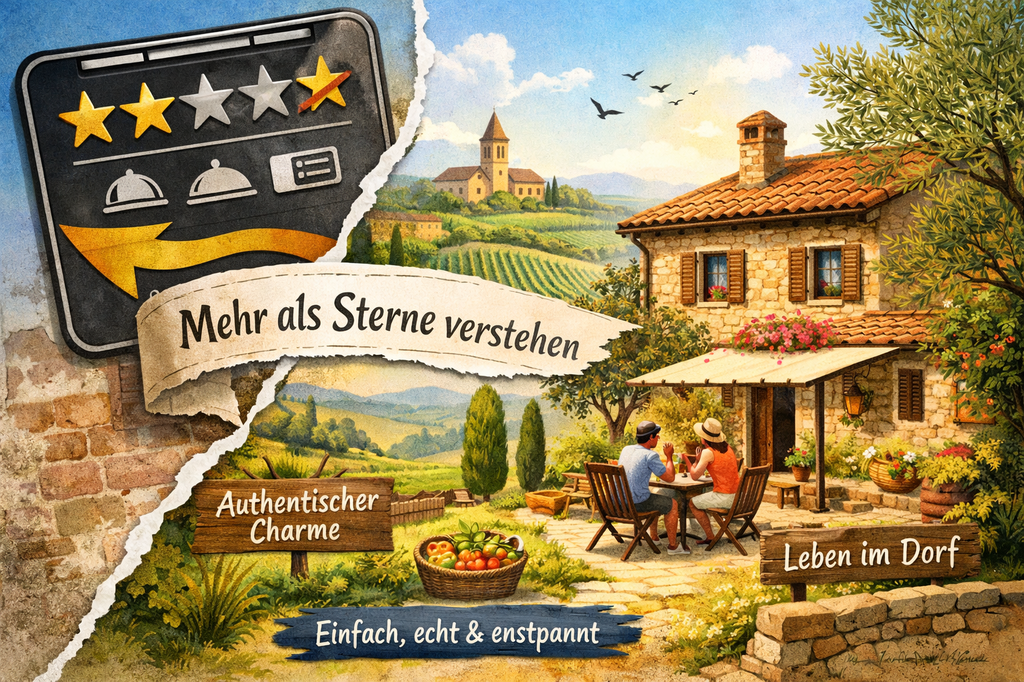
Many holidaymakers start their search for accommodation in Italy with a familiar benchmark: stars. Three stars are considered solid, four comfortable, and five luxurious. This system conveys security, comparability, and a seemingly objective orientation.
But this is where the misunderstanding begins. Italian holiday homes operate according to different rules. They are rarely standardized, hardly comparable, and almost never clearly rated by stars. Those who try to measure quality based on symbols or categories often overlook the essentials.
This article explains what truly makes a good holiday home in Italy, why stars hardly help – and which criteria instead contribute to a successful holiday. Not promotional, but explanatory. Not promising but clarifying.
Why the star system is not very informative for holiday homes
The classic star system was developed for hotels. It is based on standardized services that can be easily compared: reception, gastronomy, daily service, room sizes, additional offers. Holiday homes, on the other hand, are mostly not professional accommodations but private properties that are – in part – used for tourism.
Regional differences in evaluation
In Italy, there is no nationwide standardized evaluation system for holiday homes. Some regions award stars, others work with categories or symbols, and many completely forego official classification. This creates an illusion of comparability that does not exist.
The focus on the essentials is missing
A star system can neither capture the living atmosphere nor the everyday practicality or the authenticity of a house. However, this is often where the actual quality lies.
Italian holiday homes: Places rather than products
Italian holiday homes are often not properties specifically created for tourism. Many of them are former residential houses, agricultural buildings, or historically grown structures that come with their own history. These houses were built for use rather than comparability – a fact that is felt.
Charm through individuality
This very origin gives many holiday homes their charm. No house is like the other. The floor plan, the materials, the shutters, the inner courtyards – they are expressions of the region, the time, the owners. What is a lack for one person is character for another.
A home, not a resort
A good holiday home in Italy is rarely a retreat without context. It exists within the social, cultural, and geographical framework of its location. This integration adds depth – and requires openness from the guests.
What truly makes a good holiday home
The location is a decisive factor that cannot be categorized. It is not just about how beautiful the view is, but also about how easily the house can be reached, whether it is practical for everyday use, or whether one can find peace or connection there. A modern house in the wrong location can feel much less fitting than a simple but well-situated property.
Architecture, substance, and climate
Many Italian houses are built to function with the climate: thick walls, small windows, natural materials. This building style is not modern in a design sense but functional in daily life. It protects against heat, regulates temperature, and creates retreat spaces. A good holiday home does not need to win design awards. It must bring together the needs of the location and the travellers.
Functionality in daily life
The kitchen should not just look beautiful but be usable. The shower should not only be modern but pleasant to use. Shutters, faucets, light switches – what works is hardly noticed in daily life. What does not work negatively shapes the stay. Good holiday homes offer smooth seamlessness. No technical gimmicks, but a reliable structure.
Authenticity as an experiential value
What many travellers seek is not a standard, but experience. A holiday home that reflects the place, uses materials from the surroundings, and organizes spaces as is customary there – all this can deepen the stay. This authenticity cannot be booked but can be experienced.
Outdoor living as part of quality
Terraces, courtyards, loggias, or small gardens are part of a good holiday home. They create transitions between inside and outside, allow for meals in the shade, siestas under a tree, or conversations in the evening light. In hot regions, they are more than an addition – they are essential.
Design with climate and surroundings
A good outdoor area does not follow design trends but the requirements of the location. It provides protection from sun and wind, blends into the landscape, and creates space for encounters or retreats.
The social context: Neighbourhood instead of anonymity
Many holiday homes are not isolated but part of established structures – a village, a neighbourhood, a small community. This proximity brings sounds, encounters, everyday moments. For many travellers, this is a real added value. A good holiday home does not ignore its surroundings but opens to them.
Hospitality as an attitude
In Italy, hospitality is not a service but an attitude. The quality of care is measured not by the number of additional services but by the willingness to communicate, to assist, and to maintain respectful distance. A good host is approachable but not intrusive.
Everyday usability: the underestimated comfort
Romanticised seclusion can be exhausting in everyday life. Anyone who drives half an hour for every shopping trip loses their spontaneity. A good holiday home is located so that everyday necessities remain accessible – without jeopardising the tranquillity of the place. The most beautiful vacations are often those in which everyday life becomes pleasant. Making breakfast, cooking, reading, going for a walk, shopping – all this works in a good holiday home, without much planning. The comfort lies not in extras, but in the ease of the ordinary.
Bringing expectations and reality into alignment
Many disappointments arise when expectations do not match reality. Stars give a sense of control – but they are based on criteria that are often not meaningful for holiday homes. Those who let go of this often discover more suitable houses.
Selection with attitude
Choosing a holiday home is not just a matter of amenities, but also a matter of attitude. Am I ready to embrace a different living concept? Do I value functionality over perfection? Do I want to experience or compare? Good decisions arise from the right questions.
Conclusion: Quality is a matter of fit
A good holiday home in Italy cannot be recognised by symbols. It reveals itself in everyday life, in the interplay of place, house, travel time, and expectation. Not stars, but substance, location, functionality, and atmosphere are what matter. Those who are willing to listen to the language of the house – its peculiarities, its surroundings, its history – will be rewarded: with a vacation that is not only well-planned but well-lived.
Not because everything is perfect. But because it fits.