
- Village Festivals Few Know About – When A Trip To Italy Is Truly Worthwhile
- Quality During A Holiday In Italy Cannot Be Counted – But Understood
Why the question of the “best time to travel” to Italy often leads us astray
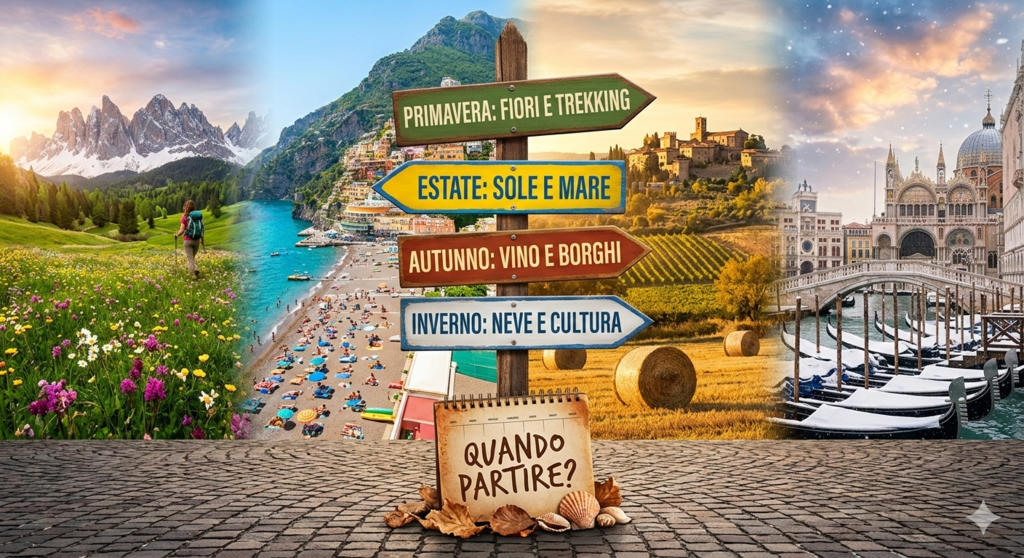
“When is the best time to travel to Italy?” – a question that almost inevitably arises as soon as a trip to Italy is being planned. Whether in search engines, travel forums, or conversations with friends, the answer seems nearly always the same: spring and autumn, May and September. These months are considered pleasant—not too hot, not too cold, little rain, moderate prices. A simple answer that promises orientation. Yet precisely because it appears so simple, it deserves a second look.
Italy is not a homogeneous travel destination. It is an incredibly diverse country in geographical, climatic, cultural, and infrastructural terms. What applies to one region may not apply to another. And what seems “ideal” to one traveller may be unsuitable for another. The notion of a universal “best time to travel” to Italy is not only misleading—it is often the beginning of false expectations.
Italy is not a uniform destination
From the Brenner Pass to Lampedusa, Italy stretches over more than 1,200 kilometres in a straight line. Its climatic range spans from Central European alpine conditions to subtropical Mediterranean warmth. The Dolomites, the Po Valley, Tuscany, Campania, Sicily, or Sardinia—all represent distinct seasons, rhythms, and experiences.
Spring in South Tyrol may still mean snow at higher elevations, while in Sicily lemon trees are already in bloom and the first brave swimmers enter the sea. Autumn in Apulia can feel summery, while Milan is already experiencing rain and fog. Anyone traveling through Italy is never traveling through an entire country, but always through a specific place with its own rules.
The importance of regional differences
Even within a single region, climate and atmosphere can vary significantly. In Tuscany, for example, conditions in coastal towns differ greatly from those in the hills around Siena or in the Apennine ranges. The travel experience also changes accordingly: the sea may still be cool in the shoulder season, while hikers enjoy blooming hillsides. The same date does not mean the same experience.
The origin of the “best time to travel” – and its fallacy
Online travel guides, weather charts, and rankings must compress information. They rely on averages, generalizations, and simplifications. This is understandable—but problematic when such simplifications are mistaken for truth. Terms like “best time to travel” or “optimal months” are SEO-friendly but of limited use for nuanced travel decisions. They suggest objectivity where subjective assessments should prevail. After all: “Good” for whom? “Ideal” for which type of travel? “Pleasant” in relation to which goal? Most answers fail to provide this context.
Between weather data and travel expectations
Many recommendations are based on climate tables. Yet weather alone is not a reliable indicator of travel quality. Three days of sunshine in Rome may be a dream for one person and exhausting for another. A mild spring day in Florence may be perfect for sightseeing—or too cool for the planned aperitivo on the piazza.
Travel time Is not a formula, but a balance
What matters is not when “Italy” appears most friendly on the calendar, but when a specific place aligns with one’s personal expectations. A beach holiday requires different conditions than a museum trip or strolling through medieval towns. Those who want to experience the grape harvest will choose different months than those interested in truffle markets.
The chosen mode of travel also plays a role. Independent travellers have different needs than families with children. Cyclists look for dry days with mild temperatures, hikers for cooler periods. Those relying on public transport depend on different infrastructures than those traveling by car.
The role of one’s personal life situation
The influence of one’s life phase should not be underestimated. Working people bound to school holidays must consider different time frames than retirees. People with small children, special mobility needs, or extensive travel experience all bring their own requirements and limitations.
High season: popular, but not always ideal
The summer months of July and August are considered the “classic” travel season for Italy. Yet they are not automatically the best months. In many places, not only temperatures rise, but also visitor numbers. Cities become crowded, prices increase, and infrastructure reaches its limits. Many Italians go on holiday themselves; shops close, services change. At the same time, summer brings a different pace of life. Life shifts into the night, lunch breaks grow longer, schedules change. Anyone expecting “business as usual” may be surprised.
Between atmosphere and effort
This does not mean that summer travel should be avoided. But it requires a different mindset. Those willing to embrace heat, crowds, and altered rhythms can have intense experiences. Those expecting cool weather and empty squares will be disappointed. High season is not bad—it is simply different.
Low season: less offer, more connection
Outside the summer months, Italy reveals another side. In the shoulder and low seasons—late autumn or early spring—many places move at a different pace. There are fewer events, but more everyday encounters. Less tourism, but more authentic impressions. Some places seem deserted; others show themselves at their very best. Those seeking Italian daily life, local markets, conversations in bars, and open churches often find better access in the low season.
Less choice, but often more depth
Yes, not everything is open. Some museums reduce their hours, some hotels close. But the places that remain often have more time. Conversations last longer, recommendations are more honest, experiences more immediate. The low season is not a second choice—it is a different way of traveling.
Travel time as an attitude
The question of the best time to travel is often an expression of a desire for control. When is the weather stable? When is it not too crowded? When are conditions predictable? These questions are legitimate, but they fall short. Italy is not always predictable. It does not follow booking logic—it follows its own dynamics. Those who travel to experience resonance do not need a perfect forecast, but openness, spontaneity, and a willingness to engage with what comes. This is not a rejection of planning, but a plea for a different way of asking questions.
Not the date determines the journey, but the fit
Great trips emerge where expectations, place, and timing align. A rainy day can be beautiful if it suits the destination and the mood. An empty place can be moving if approached with the right mindset. The best time to travel is not a date—it is an interaction.
Conclusion: from calendar to experience
Italy is too diverse, too dynamic, too alive to be reduced to a few months. The search for the best time to travel may promise orientation but often leads to disappointment—not because Italy disappoints, but because the question was too simple. A better question would be: What am I looking for? What do I really need? What can I let go of? The answers to these questions usually lead to better decisions than any climate table.
Italy does not reward perfect planning.
It rewards the willingness to engage.
At any time of the year.