
Vendemmia: Experience the grape harvest in Tuscany up close
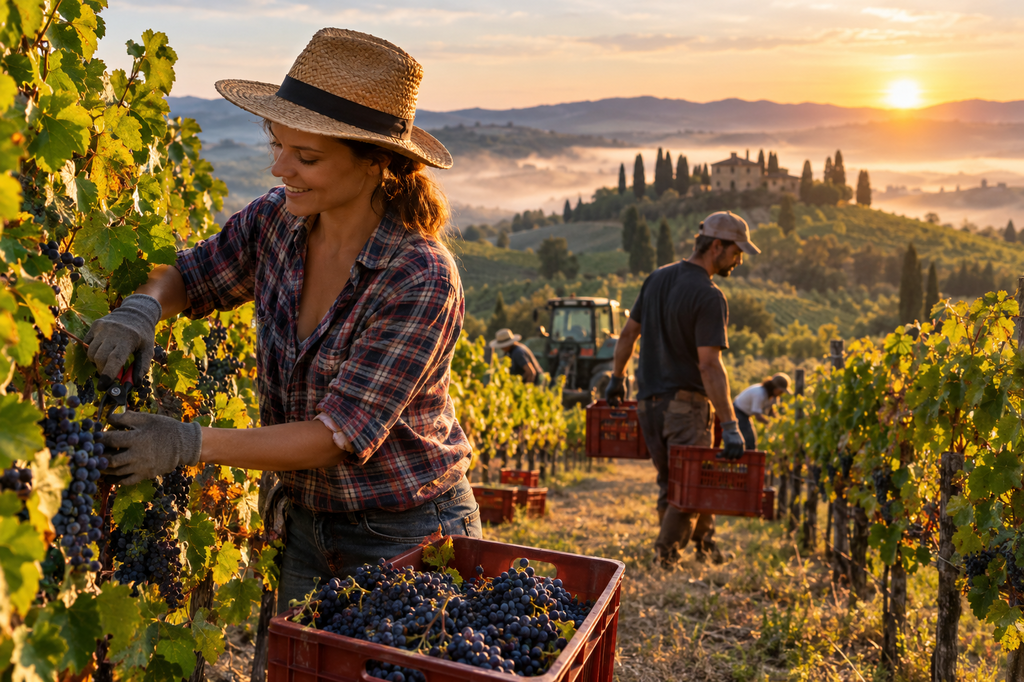
Half past five in the morning, still dark. Mist rises from the valley; somewhere, crates clatter against one another; a tractor sputters into action. Someone shouts something across the rows of vines; the echo sounds like laughter. In the Chianti hills, this is usually how the day begins when the Vendemmia gets underway – the grape harvest, the most emotional event in the Tuscan calendar. Between early September and mid-October, travellers can not only observe this moment but also play an active part in it. With your hands in the grapes, the sweetness on your tongue, and a view of hills just beginning to turn gold, red and deep green – renting a holiday home at this time of year means immersing yourself in this rhythm.
Not a single day, but weeks
The grape harvest is not an event that can be ticked off on a single calendar day. Depending on the grape variety, altitude and aspect of the vineyard, it stretches over six or seven weeks. Sangiovese, the main grape variety of Chianti, usually ripens from late September to early October. Vermentino, on the other hand, an early-ripening white variety, can be harvested as early as August. So anyone arriving in September who finds nothing in Chianti need only drive ten kilometres further – there’s always a harvest going on somewhere. Surprisingly, harvesting is still often done by hand, particularly on the steep slopes of the Chianti Classico zone or at traditional estates in the Maremma. The reason is pragmatic: machines cannot distinguish between ripe and damaged grapes. A person with a pair of secateurs can.
Try your hand at pruning
Numerous agriturismi and family-run wineries open their vineyards to guests during these weeks. You’re given a brief introduction, a pair of vine shears and a bucket – and then you find yourself standing between the rows whilst the winemaker explains what matters when it comes to the colour of the grapes. After an hour or two, you get a feel for why experienced pickers manage to harvest twice as much as a beginner in the same amount of time. This is often followed by the ‘pigiatura’: the traditional grape-stomping with bare feet, nowadays mostly a light-hearted, symbolic part of the programme rather than actual winemaking. Afterwards, there’s a tasting – not just of the finished wine from the previous year, but of the ‘mosto’, the freshly pressed grape juice. Sweet, slightly fizzy, and still without a drop of alcohol. Those tasting it for the first time are usually surprised at how little it resembles wine and how much it tastes of pure grapes. Children are rarely mere spectators on the sidelines during all this. Many estates deliberately plan the morning to be child-friendly: small tasks, a ride on a trailer through the vineyards, followed by a communal lunch in the open air with bread, grapes and olive oil from their own production.
What happens to the grapes once the crate is full
Anyone who has picked grapes themselves wants to know what happens next. Processing usually begins on the very same day: the grapes are destemmed, separated from their stems, then – depending on the style of wine – gently pressed or placed directly into open vats for maceration. With Sangiovese, the length of time the grapes spend on the skins determines the colour, tannins and structure of the resulting wine – the longer the contact, the more powerful the wine. In smaller wineries, you can smell the fermentation beginning even from the doorway: a sweetish, almost heavy scent.
You can hear the soft bubbling of the vats. Some winemakers even let guests push down the ‘cappello’ – the cap of skins that rises to the surface during fermentation and is traditionally submerged by hand several times a day. Anyone who has done this once will not forget the smell in a hurry. The ageing process that follows takes months, sometimes years. Classic Chianti usually matures in large wooden barrels. Brunello di Montalcino is subject to legally prescribed ageing periods lasting several years before it can even be sold. During the vendemmia, several vintages often stand side by side in the vaulted cellars – an archive you can literally walk through.
What’s on the menu
The cuisine changes noticeably during these weeks. Wild boar ragout with pappardelle, roasted chestnuts as a side dish, hearty bean soups for the cooler evenings. A staple at many wineries is schiacciata all’uva – a flat focaccia-style bread topped with whole grapes, baked during these very weeks so that the sweet juice soaks directly into the bread. Anyone taking part in an organised harvest day usually eats together outdoors: long tables set up between the rows of vines, homemade pasta, local pecorino, accompanied by the estate’s wine, often from several vintages for comparison. At this table, what starts as a simple harvest experience quickly becomes something more personal – you sit together with the winemaker’s family, not just next to them.
A look back
Winegrowing in Tuscany dates back well before the Middle Ages. The Etruscans were already cultivating vines here long before the Romans spread their cultivation techniques throughout Italy. The name Chianti appears as early as the 13th century, and shortly afterwards the Lega del Chianti was established as one of the earliest attempts to legally protect origin and quality – a forerunner of today’s DOCG classification. So, anyone standing in a vineyard during the vendemmia is not simply standing in a beautiful landscape. They are standing in a landscape that has been cultivated according to the same basic principle for over two thousand years, even though techniques and knowledge have, of course, advanced enormously since then.
Organic viticulture as a growing trend
More estates are now turning to organic or biodynamic cultivation. For visitors, this often means a more immediate experience of nature: wildflowers instead of tractor tracks between the rows, sheep for natural weed control, and a noticeably more relaxed pace of work. The number of such estates is growing particularly in the Maremma and southern Chianti, and their owners are usually happy to explain why they have chosen this more labour-intensive path.
The family behind the wine
What moves many visitors most is rarely the wine alone. Most Tuscan estates outside the major brands are still family-run businesses, now in their third, fourth, or sometimes fifth generation. This becomes evident during the harvest: grandparents showing their grandchildren how to prune the vines, children playing amongst the rows, a palpable sense of being part of a chain that began before one was even born. Anyone who immerses themselves in this experience becomes, for a few hours, part of a ritual whose basic structure has scarcely changed – even though modern cellar technology has long since been introduced.
Where the grape harvest remains particularly unspoilt
Chianti is the heart of Tuscan winegrowing, with such a density of vineyards and borghi that it allows for several harvests in different locations in a single trip. Montalcino, home of Brunello, traditionally harvests a little later, often until mid-October, in a particularly dramatic hilly landscape. The Maremma is less crowded and more unspoilt. Here, vineyards often border directly on pine forests, and the sea is not far away. The Val d’Orcia, a UNESCO World Heritage Site between Pienza and San Quirico d’Orcia, combines vineyards with the famous cypress-lined avenues to create one of Italy’s most photogenic landscapes.
Practical information
The dates vary each year, depending on the weather and the ripeness of the grapes – flexible travellers have the best chance of getting caught up in an active grape harvest. Sturdy footwear and clothing that can get dirty are essential. Many estates ask for advance booking, as capacity for visitor groups remains limited during the harvest; the actual work in the vineyard always takes priority. Siena, San Gimignano and Volterra are all just a short drive away from most wine-growing regions – ideal for day trips in the days between two harvest dates, without sacrificing the rural rhythm of your holiday home. And then there’s the light. September and October bring a soft, golden afternoon sun to Tuscany, reflected in the vine leaves that are already beginning to change colour. A walk at golden hour through a vineyard where the harvest is in full swing – for many travellers, the real highlight of a year in Tuscany, more intense than the often sweltering, overcrowded height of summer.
Frequently asked questions about the vendemmia in Tuscany
When does the grape harvest take place in Tuscany?
Between late August and mid-October, depending on the grape variety and region. The peak for Sangiovese is usually between mid-September and early October.
Can holidaymakers help with the grape harvest?
Yes. Many agriturismos and smaller wineries offer experience days where guests can pick grapes themselves under supervision. It’s advisable to book in advance.
Is the vendemmia suitable for children too?
Absolutely – many estates tailor the programme to suit children, with shorter harvesting sessions, rides on trailers and a meal together afterwards.
Which region is best suited for a vendemmia holiday?
Chianti offers the highest concentration of accessible vineyards, Montalcino offers tradition and prestige, whilst the Maremma offers unspoilt charm and proximity to the sea.
What should you bear in mind when booking a holiday home this season?
Book well in advance, as demand is rising, and if possible, choose a house with a kitchen near a vineyard so you can take part in grape-picking sessions at short notice.
Renting a holiday home in Tuscany during the Vendemmia means not only seeing the Italian autumn but also tasting it and experiencing it first-hand. ItalicaRentals will help you find the perfect country house for this very season.