
- Discover Calabria: Italy’s Wild South, Far From The Crowds
- High Season Or Low Season In Italy: When Is The Best Time To Visit – And For Whom?
Holiday home in Sicily: What sets the island apart from the mainland – and why that matters for your holiday
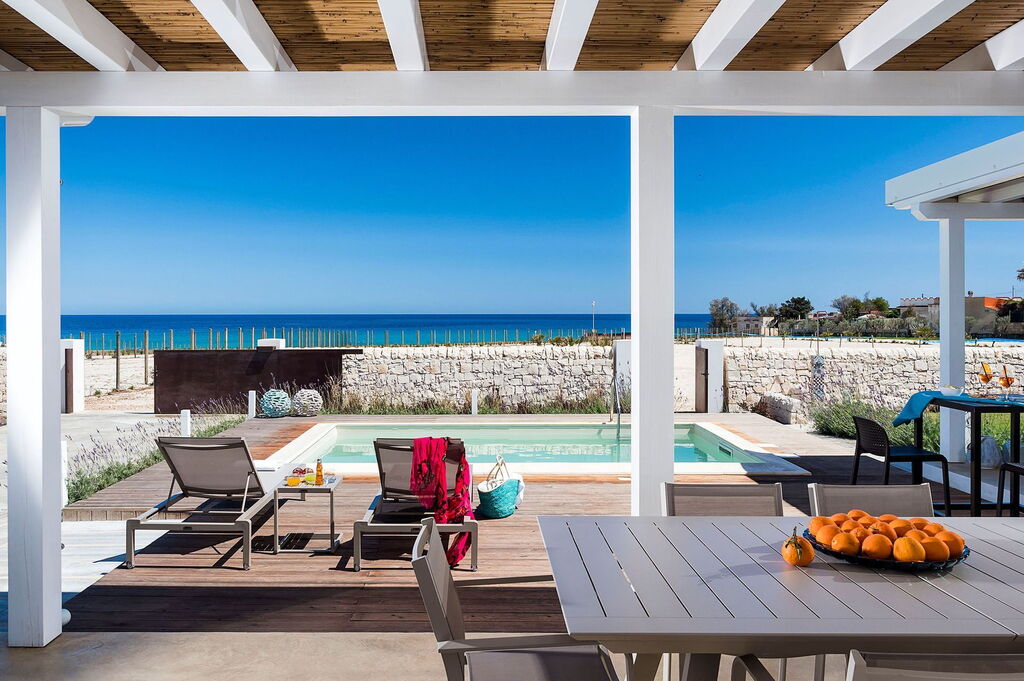
There comes a moment when you’re standing at a bar in Palermo – any bar that isn’t in the guidebook, in an alley whose name you haven’t bothered to remember – and an elderly gentleman next to you pushes his espresso aside, glances at you briefly and says: “Sai, qui non siamo in Italia. Siamo in Sicilia.” You know, we’re not in Italy here. We’re in Sicily.
This is no joke. It is the most sober description of the island you can get. Sicily is part of Italy – politically, linguistically, geographically. But it is also something else – something left behind by the Greeks, the Arabs, the Normans and the Spaniards. Something shaped by the sea from three directions and redefined by Mount Etna every day. Anyone who has been here once and understood this will return with a new perspective.
This article explains why that is – and what matters most for a holiday home break on the island.
What sets Sicily apart from the mainland
Tuscany has a summer. Sicily has a long season. As early as April, the water on the south coast starts to become swimmable. In May, people sit in T-shirts in the piazzas in the evenings, and the almond trees near Agrigento bloom so white that from a distance it looks like snow on the hills. In October, the sea is warmer than July in many northern Italian cities, and in November, Sicilians are still drinking their espresso outdoors.
But what this heat does in July and August is another story. When the Scirocco arrives – that wind from the Sahara that scatters desert dust across the island – temperatures soar to 40 degrees. The air feels like woollen blankets and even the locals stay indoors during the day. Anyone planning a trip to Sicily in the height of summer should bear the midday heat in mind: beach and excursions in the morning, a siesta as a sacred obligation, life resuming from late afternoon.
The culture – layered like a tiramisu
In Palermo there is a cathedral that encapsulates the island’s history within a single building. It features Arab arches from the tenth century, Norman towers from the twelfth, Gothic extensions from the fourteenth and Baroque ornamentation from the seventeenth. Standing before it, one sees not a building, but centuries.
That is the fascinating thing about Sicily: here, history is not on display but layered. The temples in Agrigento are older than the Colosseum, better preserved than the Parthenon, and they stand in a landscape that has hardly changed in two and a half thousand years. In Syracuse, you walk along a street that Cicero knew and buy bread in a bakery built on the foundations of a Greek temple.
Those who admire the Renaissance in Tuscany admire in Sicily what came before the Renaissance – and what Italians north of Rome never had: the Orient right on their doorstep.
The cuisine – Italy’s most distinctive regional cuisine
Sicilian breakfast: Granita di mandorla with a brioche fresh from the oven. Almond sorbet in a sweet roll. Sweetness plus summer air. Anyone who has tried it once wonders why cappuccino and cornetto were ever considered breakfast.
That is just one story among many. Caponata – a sweet-and-sour aubergine dish with pine nuts and capers. Pasta alla Norma – tomato, aubergine, ricotta salata, in a combination that seems so simple that one cannot understand why it tastes the same anywhere else. Arancini – deep-fried rice balls, filled with ragù in Palermo, with butter and cheese in Catania (a dispute between East and West that has been going on for centuries). Cassata, cannoli, granita – desserts that bear the legacy of the Arabs.
And to accompany them, the wines: Nero d’Avola, the dark south, as robust as a midday glass; Etna Rosso from the volcano, mineral and cool; Marsala, discovered by accident when an English merchant sought to fortify Sicilian wine with brandy for transport and invented a drink that conquered the world.
The atmosphere – more southern than anywhere else in Italy
A Sicilian piazza at 10 pm in June: grandparents on folding chairs, children playing football between the tables, men in shirts arguing about politics in loud voices, women crossing the street in groups. The whole town seems to be out and about. This isn’t tourism. This is everyday life.
This is exactly what many travellers seek in Sicily without realising it: a vibrancy that other regions of Italy – including Tuscany – no longer possess in this form. Those seeking tranquillity head to Umbria. Those seeking life head to Sicily.
The regions of Sicily: the right spot for everyone
Palermo is one of Italy’s most intense cities. Lively, chaotic, incredibly rich in history, full of markets that are still real markets – the Ballarò and the Vucciria are sensory experiences, not tourist attractions. Anyone who doesn’t like Palermo hasn’t got it. Those who love it will return.
Cefalù, 70 kilometres to the east, is the perfect alternative: a fishing village with one of Italy’s most beautiful Norman cathedrals, a wide sandy beach right below the medieval centre and an atmosphere that remains accessible even in August. For families, for first-time visitors, for anyone wanting to combine culture and the beach.
The east coast – volcano and drama
Mount Etna dominates Sicily’s east coast. It smokes over Catania, stands in the background of Taormina, and reminds the island every day that it lies on unstable ground. Anyone driving up its slopes – a road takes you up to 1,900 metres – sees solidified lava flows from centuries past, black craters, and the blue sea beyond. An experience no one forgets.
Taormina, high above the coast, is the island’s most famous town. The Greek theatre, with views of Mount Etna and the sea, offers one of the most dramatic vistas in Europe. But Taormina is packed to the brim in the height of summer. Those who visit in May or October will see the town as it was meant to be.
For many, Syracuse is the most enchanting city in Sicily. In the 5th century BC, Syracuse was the largest city in the Western world – larger than Athens. Today, the old town of Ortigia, situated on a small island in the harbour, offers a stroll through two and a half thousand years of history, interspersed with cafés, trattorias and fish markets.
The south coast – Baroque, beaches and tranquillity
The Val di Noto is a UNESCO World Heritage Site – eight Baroque towns rebuilt according to a shared aesthetic plan following the earthquake of 1693. Noto itself, Modica (known for a chocolate made to an Aztec recipe that doesn’t melt), Ragusa Ibla – each town deserves half a day of its own, each a destination.
The beaches on the south coast between Sampieri and Donnalucata are sandy, quiet and almost deserted in September. Holiday home prices are the lowest on the island. Those seeking peace and authenticity come here.
Marsala and the West
Western Sicily is a region even many Italy connoisseurs are unaware of. Marsala as a city – not just for its wine – boasts a Punic history, Arab architecture and a wine culture unlike anything else on the island. The salt pans of Trapani, with their windmills and pink-and-white salt lakes, form one of Italy’s most distinctive landscapes. And the Aegadian Islands – Favignana, Levanzo, Marettimo – are three small, largely undeveloped islands with the clearest water in the region. Anyone taking the ferry from Trapani feels as though they are stepping into early twentieth-century Italy.
What is more enjoyable in Sicily than on the mainland
The food is more original. Breakfast alone – granita with brioche – has no equivalent on the mainland. Prices are lower: a dinner in a good Sicilian trattoria rarely costs more than 30 to 35 euros per person, including wine. The bathing season is the longest in Italy, from April to October, and on the south coast until November. And everyday Sicily – the markets, the conversations, public life – is less overrun by tourists than many classic Tuscan destinations.
What you should know – an honest assessment
There are two points that form part of honest advice: the heat in high summer and the car.
The heat in Sicily in July and August is more intense than anywhere else in Italy. Anyone visiting during this time should plan around midday and opt for a holiday home with air conditioning or at least thick stone walls that retain the cool of the night.
A car is essential almost everywhere in Sicily. Public transport is not very practical for travellers; the island’s roads are no problem with a hire car, but you won’t get far without one. Those who prefer not to drive should stay in one of the towns and use it as a base.
Who is a holiday home in Sicily right for?
Sicily is for travellers who want to go a step further than Tuscany – in terms of cuisine, culture and atmosphere. It is not the Italy of gentle tourism. It is the Italy of contrasts. Those who love that will come back. Those who need comfort and predictability might be better off staying in Greve in Chianti.
Particularly suitable for curious first-time visitors, culture vultures, families wanting a long beach season, couples seeking originality, and anyone able to travel in May, June, September or October.
Less suitable for travellers who do not wish to drive, for holidaymakers sensitive to the heat in July/August, and for anyone for whom the Tuscan hills are the main attraction.
When to travel to Sicily?
In May and June, the island is at its most beautiful: warm, in bloom, lively, with moderate prices. In September and October, it combines a summer sea with an autumn climate – the smartest choice for most travellers. In July and August, only with careful planning to avoid the heat. From November to April for cities, culture, quiet days – not for the beach.
A final thought
There are those travellers who come back after a week in Taormina and say: “It was lovely, but Sicily isn’t really that different from the Amalfi Coast.” And then there are those others who, after two weeks in the Val di Noto, with day trips to Modica and Ragusa Ibla, an evening in Syracuse’s Ortigia and a morning in a bakery in Marsala, a late espresso at a bar in Palermo that isn’t in the guidebook – they return a different person. They have understood what the elderly gentleman from the opening paragraph meant. They know what it means that Sicily is Italy and yet something else at the same time. They come back.
Which of the two types of travellers you become does not depend on the booking. It depends on how you approach the island. With the expectation of sun and sand in a southern Italian setting? Or with a willingness to embrace a different way of life – one where lunch lasts two hours, the car spends half an hour in Catania’s traffic, and a granita in the morning is more important than coffee?
If you bring the latter mindset, you’re in for the best Sicilian holiday of your life.
Frequently asked questions about holidays in Sicily
Sicily or Sardinia – which is better for a beach holiday?
Sardinia has clearer, more turquoise waters and wider sandy beaches. Sicily offers more culture and cuisine on top of that. If you’re primarily after beaches, you should choose Sardinia. If you want beaches, history and food, you should choose Sicily. Those who know both love them for different reasons.
Which region of Sicily is best suited for families?
Cefalù on the north coast for beaches and village charm; the Val di Noto and the south coast for peace and quiet and more affordable prices. Taormina is enchanting, but too crowded for families in the height of summer.
When is the sea in Sicily warm enough for swimming?
From mid-April on the south coast; realistically comfortable from late May; peak in August. Still excellent in October; possible on the south coast until November.
Do I absolutely need a car in Sicily?
Not essential for city breaks in Palermo, Catania or Syracuse. For everything else, yes – the island is difficult to explore without a hire car.
What is the biggest difference between Sicily and Tuscany as holiday home destinations?
Tuscany: gentler, more refined, more familiar. Sicily: louder, more intense, more exotic. Both have their merits – but anyone who has experienced both knows that they are two very different types of holidays.
Conclusion
Sicily is not a holiday in Italy in the traditional sense. It is a travel experience, sharing with Tuscany, Lake Garda or Amalfi only the language and nationality. Those who understand this and arrive with this in mind are best placed to enjoy an unforgettable holiday. Anyone who arrives in Sicily with expectations of Tuscany — gentle tourism, well-balanced infrastructure, predictable restaurant quality — will be disappointed. Sicily is more intense. Noisier. Rougher. And, at its best, incomparable.
The strategic advice for first-time visitors: plan for at least ten days, hire a car, choose a region as your base (ideally Val di Noto or the east coast around Syracuse), and explore the island from there. Those travelling in May, June, September or October will experience the island at its most relaxed. Those who come in August should plan around the midday heat and accept that the pace is different from that in the north.
What many travellers to Sicily have in common is the phenomenon of returning. Once you’ve been here and understood it, you rarely come just once. The island has a depth that cannot be fully grasped in a week. And that is perhaps its finest promise: with every visit, it becomes a different Italy.