
- Holiday Home In Sicily: What Sets The Island Apart From The Mainland – And Why That Matters For Your Holiday
- Holidays For The Over-60s In A Holiday Home In Italy: Why Now Is The Perfect Time For The Most Wonderful Holiday
High season or low season in Italy: When is the best time to visit – and for whom?
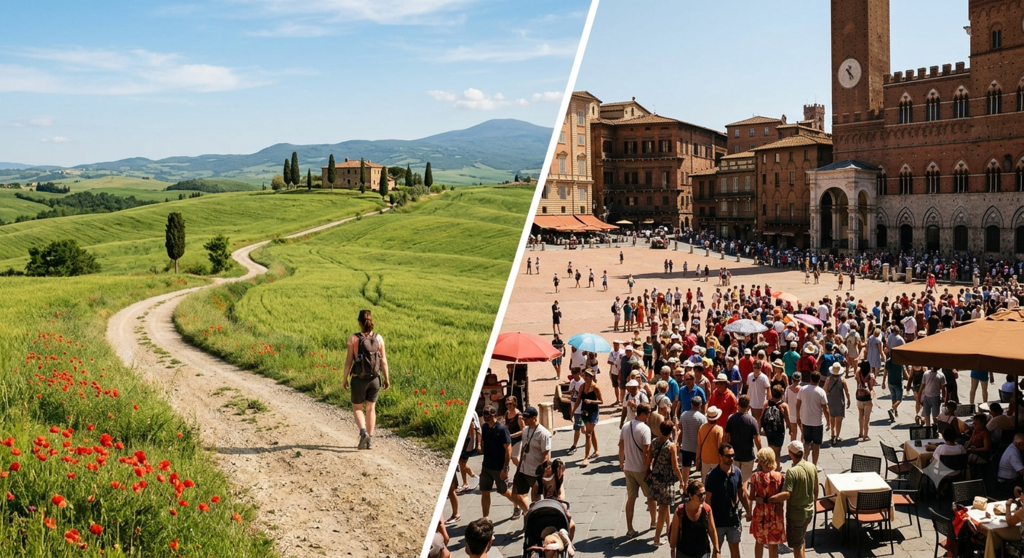
There is a moment in May, somewhere in Tuscany, when the world stands still for a few seconds. The poppies stand red in the hillside pastures, the cypresses cast long shadows, the air smells of wisteria, and somewhere down in the valley a church bell tolls at midday. No one else is there. No tourist bus, no queue outside the trattoria. For a moment, Italy belongs to whoever happens to be standing there.
There is another moment in August, in the same Tuscany, when the world becomes very loud. The sun beats down mercilessly on the piazzas. The restaurants are fully booked. The car park at the Cinque Terre costs sixty euros, and on the way to San Gimignano you’re stuck in a traffic jam for half an hour.
Both are Italy. Both have their place. But which of these two versions you choose to visit should not be a matter of chance.
What the high season in Italy really means
The Italian summer is more intense than the northern one. The high season officially runs from mid-June to the end of August, culminating around Ferragosto on 15 August, and is a phenomenon during this period. The Italians themselves leave their cities and flood the coast. Florence in August is half-empty, the hills around Lucca are full. Prices for holiday homes double. Temperatures in the interior regularly rise above 35 degrees, and restaurants on the Versilia coast require reservations made two weeks in advance.
There is no denying that this has a special charm. Anyone who has ever experienced Ferragosto in the piazza of a small village understands why some travellers deliberately time their holidays to coincide with these very days. Just look at the fairy lights strung between the houses, the families with three generations gathered around a single table, the fireworks over the market square and the spontaneous music that starts somewhere between the main course and dessert and carries on past midnight. In the height of summer, Italy shows itself in all its glory. It is loud. It is warm. It is strangely touching, like a country that has decided, once a year, to celebrate everything at once.
But what the high season demands relentlessly is preparation. Those who book three months before August still have a choice. Those who look three weeks beforehand take what’s left – and pay the high-season price for it. Anyone wanting to get a table at a popular trattoria in Tuscany in July or August should ring days in advance. Anyone wishing to buy a ticket for the Borghese Gallery in Rome or the Uffizi in Florence should purchase it online in advance. In August, spontaneity is the most expensive trait a traveller can have.
What the off-season means in Italy – and why it isn’t just the off-season
Here lies one of the travel industry’s best-kept secrets: Italy doesn’t have one off-season, but three. And each one is more appealing for certain types of travellers than the whole of summer put together.
Spring – when Tuscany remains its own little Italy
In May, you can sip your espresso at a free table in Greve in Chianti. In April, you stand in Siena’s Piazza del Campo, and the square is spacious enough to lose yourself in. In June, the sunflower fields are ablaze. The sea is just warm enough for the brave, and the hiking trails through the Crete Senesi are so quiet that you can hear the lizards rustling in the walls.
Spring is the season when Italy truly gives itself away: excellent weather at drastically lower prices, empty sights, lively markets without tourist groups, restaurants that have time to look after each individual guest. The only catch: the sea is still a bit chilly in May (18–20 degrees), but pleasant by June (22–24 degrees). If swimming is your priority, wait until the end of June.
Autumn – the season for connoisseurs
Anyone who has ever been to Tuscany in September or October is unlikely to return at any other time of year. Here, autumn is not a transition to winter – it is a peak season, just without the tourists. In Chianti, the vines are red and gold. The grape harvest is in full swing in the wine cellars, and every other village hosts a sagra: a festival celebrating local wine, olive oil or truffles. You sit at long tables beneath lime trees, eat wild boar ragù from large bowls, drink wine from unlabelled carafes and feel as though you’re sharing in a secret.
Water temperatures in September are still at summer levels (24–26 degrees); it only cools down noticeably in October. Daytime temperatures hover around a pleasant 22–28 degrees – perfect for hiking, for visiting towns, for everything that would be too strenuous in August. And above it all is that light that has made Tuscany famous: softer, more golden, clearer than in summer.
Winter – Italy beyond the postcards
Winter in Tuscany does not fit the Mediterranean cliché. It can get cold, it sometimes rains for days on end, and some medieval stone floors make you feel the chill like nowhere else. But then there are those days between Christmas and mid-February when the sun is low in the sky, the hills are bathed in clear light and the cities – Florence, Siena, Lucca – are finally their true selves. Without the crowds, without audio guides, without five languages spoken simultaneously in every alleyway.
Anyone who rents a country house with a wood-burning stove in January gets a holiday that has nothing in common with summer – and which, for many travellers, is all the more enjoyable for that very reason. Prices are a quarter of what they are in August. The restaurants have time. And the wine tastes different by the fireside anyway.
Month by month – the honest guide
|
Month |
Climate |
Sea |
Tourists |
Prices |
Ideal for |
|
April |
16–22 °C, occasional rain |
16–18 °C |
Low |
Affordable |
Hiking, culture, blossom |
|
May |
20–26 °C |
18–20 °C |
Low-Medium |
Affordable-medium |
Almost everything except swimming |
|
June |
24–30 °C |
22–24 °C |
Medium |
Medium |
Beach and culture – the best balance |
|
July |
28–36 °C |
25–27 °C |
High |
High |
Water, families with children |
|
August |
30–38 °C |
26–28 °C |
Very high |
peak |
Only if you’re absolutely sure |
|
September |
24–30 °C |
24–26 °C |
medium |
medium |
Beach, reading, sagre| |
|
October |
18–25 °C |
20–22 °C |
Low |
Good value-medium |
Wine lovers, truffles, tranquillity |
|
November |
12–18 °C |
18 °C |
Very low |
Very affordable |
cities, thermal springs |
When is best for which type of traveller?
Families with school-age children
They have no choice, and they know it. The school holidays dictate the dates – July, August, early September. What remains are the smart choices within these constraints: preferring the first week of July to the last week of August. Choosing the Tuscan hinterland over the Versilia coast. Booking very early – ideally by February – to secure even better value on the top properties. Those who do so will experience a summer that, despite being peak season, will be a good one.
Couples and leisure travellers
Those not tied down by school holidays should visit in May, June or September. Full stop. This is when Italy is at its most beautiful. This is when the balance of price, weather, atmosphere and tranquillity is at its best. Anyone who has ever stayed in a country house in Chianti in May – breakfast on the terrace with a view of poppy fields, lunch in a village trattoria, an afternoon in the shade of olive trees – will understand that any other time of year is a second choice.
Hikers and active holidaymakers
The Italian summer is not recommended for long hikes. The heat turns hiking trails into a little hell at midday. April, May and June are the active months of spring; September and October those of autumn. Anyone walking the Via Francigena, the Chianti Sentiero or the Cammino di San Francesco – they set off during one of these periods, and never in the height of summer.
Beach and swimming holidaymakers
The Tyrrhenian Sea becomes pleasant from mid-June and remains suitable for swimming until early October. Those choosing Sicily or Sardinia have a significantly longer season – on the southern coast of Sicily, it runs from mid-April to early November. Those heading to Versilia or the Ligurian coast to swim, however, should visit between June and September.
Wine lovers and culinary travellers
There is only one month that knows how to choose between grape juice and wine: October. The harvest is in full swing, the harvest festivals come thick and fast, the first truffles emerge from the woods, and the trattorias serve dishes that aren’t on the menu in August. Anyone who sees Italy as a culinary journey books October – and comes back next year.
What the off-season really saves
The figures are clear. A four-bedroom country house with a pool in Tuscany costs between €3,500 and €5,000 per week in August. The same property in June: €2,200–€3,200. In May or October: €1,600–€2,400. In February: often under €1,200.
These aren’t special cases. This is the normal market. If you’re flexible and opt for a week in October instead of a week in August, you’ll save between €1,500 and €2,500 on a comparable property – and experience a different, often more beautiful side of Italy.
Those who are even more flexible should look out for last-minute deals: spontaneous bookings in the off-season are sometimes advertised with further discounts, as landlords would rather accept a lower price than have an empty week.
What a day in the off-season feels like
It is early October, Wednesday, half past eight in the morning. In the small village where the holiday home is located, you can see through the open windows: the woman from the house next door is hanging out the washing. The baker is shoving the last batch of bread into the oven. In the piazza, two men have sat down in front of the bar with their espressos, showing each other something in the newspaper. There is a certain stillness in the air that would be impossible in August – no groups, no babble of voices in three languages, no coaches causing traffic jams.
You pop to the bakers. Buy a slice of schiacciata, a croissant or two, a loaf of bread for lunch. The baker asks if you’re staying on again, and the guest in front of your nods, smiles, as if you belong. A quarter of an hour’s chat about the weather, about the next sagra in the village at the weekend. No one is in a hurry.
That is what off-season Italy really sells: time. The time to develop a connection with the place. The time that tourism eats up elsewhere.
Frequently asked questions about the high and low seasons in Italy
When is the best month for a holiday in Tuscany?
If you have a choice: May and June for spring, September and October for autumn. Four months in which the weather, atmosphere and prices offer the best balance – all four without the pressure of school holidays.
When should you travel to Sardinia?
June and September offer warm seas and quieter beaches. Those who choose the Costa Smeralda in August are heading into a world that is noisy, crowded, expensive, but lively. Those seeking the island’s quieter coasts should go in the off-season.
Is September or October better for Tuscany?
September for the sea plus the first autumn colours, October for an intense autumnal atmosphere, the grape harvest, truffles and tranquillity. If you have a choice: October is unbeatable in terms of food and atmosphere.
How can I save money when booking despite the school holidays?
The first week of July instead of mid-August, inland rather than the coast, and booking early from February. A holiday home in Chianti rather than on the Versilia coast often saves 30 to 50 per cent in August for the same quality.
When is the sea in Tuscany warm enough for swimming?
From late June to early October. In September, water temperatures along the Tuscan coast are between 24 and 26 degrees – warmer than July in many northern European seaside resorts. October is still an option depending on the weather, but it’s no longer pleasant for everyone
Conclusion
The question “When to visit Italy?” has as many answers as there are travellers. But one thing is clear across all the answers: the peak season in July and August is not the best time for most holidays in Italy. It is the most expensive, the hottest and the busiest. Anyone not tied to school holidays should avoid it — and choose May, June, September or October instead.
During these months, Italy is just as many remember it from their first trip: lively but not overcrowded. Warm, but not hot. Touristy, but with room for your own discoveries. Prices for holiday homes are often 40 to 60 per cent below August levels, restaurants have time to spare, and the countryside is at its most magnificent – in May with poppies, in October with the harvest and golden light.
Those who must travel in the high season — families with school-age children have no other choice — can save a lot and enjoy themselves more with a few tricks. The following might help book early, choose the hinterland over the coast, and the first week of July rather than mid-August. If you’re flexible, you should still honestly consider whether the peak season really is the best choice. In the off-season, Italy doesn’t belong to the Italians and the tourists — it belongs to whoever happens to be there at the time.