
- High Season Or Low Season In Italy: When Is The Best Time To Visit – And For Whom?
- Golf In Tuscany: The Best Golf Courses – And How To Plan Your Holiday Around Them
Holidays for the over-60s in a holiday home in Italy: Why now is the perfect time for the most wonderful holiday
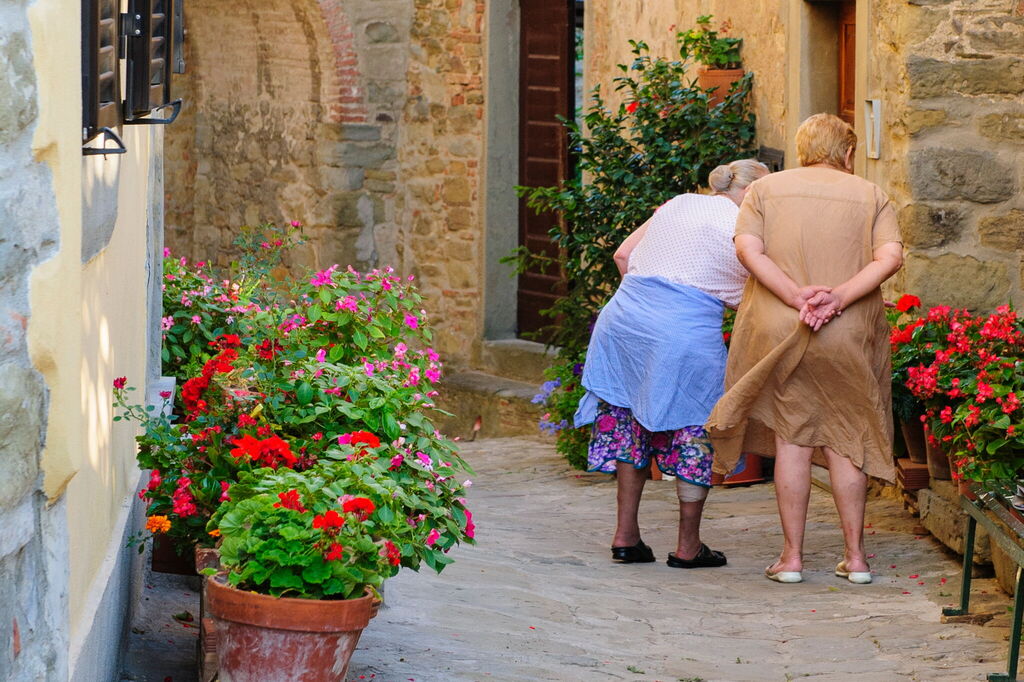
There are those travellers who have realised at some point that a good holiday isn’t about covering miles. They don’t book a hotel in Florence to visit ten museums in a week. They rent a house in an Umbrian village with perhaps a hundred inhabitants and sit on the same terrace every morning with the same cappuccino. They get to know the baker by name. By the third day, they know where the wine is at its finest. By the sixth day, they are greeted as if they belong.
That is not resignation. That is arrival. And it is an art of travel that grows with the years.
Italy rewards this way of travelling like hardly any other country. It is made for people who have time, who do not need to see everything, who prefer an excellent glass of wine to a long list of sights. Anyone travelling to Italy from the age of sixty does so under the best conditions travel has to offer: with experience, with leisure, and with the freedom to choose what matters most.
What changes about travel after 60 – and why that is a gift
There comes a moment in the second half of life when you realise that the constraints of school holidays are finally over. You can now travel in May. In October. Even in November, if you like. You no longer have to book a package holiday that ticks off all the highlights in three weeks. You can spend two weeks in a single valley without feeling like you’re missing out on anything.
What changes is not the pace of the body – that is a matter of individual choice, and many sixty-year-olds hike for hours, swim daily, or cycle through the hills of Tuscany on e-bikes. What changes is the pace of perception. You are no longer in a hurry to get back to the hotel quickly because you have eight stops to tick off tomorrow. You stay put. You ask questions. You have a second espresso, even though the first was finished ages ago, because the conversation has become interesting.
That is the exquisite luxury of travel. And Italy has perfected it.
What matters on a holiday home break from the age of 60
There are these country houses in Tuscany that are romantic but have 23 steps between the entrance and the bedroom. When you’re young, that’s part of the charm. At sixty, it becomes an issue. Not because you can’t manage the steps – but because they eventually become tiring, especially after a long day of sightseeing and one glass of wine too many at dinner.
When choosing a holiday home, it’s worth asking a few questions straight away: Is the master bedroom on the ground floor, or can it be moved there? How many steps lead to the entrance? Is there a lift or at least a ground-level area where the essentials take place? An experienced landlord will answer this honestly – and sometimes it turns out that the supposed dream home is less suitable than another that initially looked less spectacular.
More important than anything else: a first-class terrace. Comfortable outdoor furniture. Shade at midday. A pergola covered in wisteria or an old lime tree under which the table stands – in summer, this is the heart of the house. This is where breakfast is eaten, where a book is read, where a bottle is opened in the evening. Anyone who has a delightful spot here is already halfway there.
The location – what proximity to amenities really means
A secluded country house has its charm, but this comes at a price: you must drive every little thing there yourself. Anyone travelling to Italy for the first time at the age of sixty or sixty-five should consider whether they really want that. Perhaps a house on the edge of a village is the better choice: a walk to the bakers in the morning, to the market on Saturday, to the restaurant in the evening. A bit of independence that you don’t have to give up just because you’re abroad.
Those who no longer drive for long distances or prefer travelling by train and hiring a car locally will find exactly that in Lucca, Orvieto, Spello or Bardolino: towns and villages with rail links, amenities, a rich daily life and holiday homes nearby.
Getting there – what works comfortably
Driving to Tuscany in your own car is an option that many sixty-somethings appreciate. You travel with your own luggage, are flexible once there and can even stop off for a night in South Tyrol. For those who no longer wish to do so: Pisa Airport is small, straightforward and stress-free. Bologna or Florence are equally good options. A hire car once there is the simplest solution in most regions.
Travelling to Italy by train sounds more complicated than it is: the EuroCity via Munich to Verona, then the Frecciarossa to Florence – and you’ll find yourself in the heart of Tuscany by mid-morning. Those who give it a go sometimes return a changed person.
The best regions for holidays for the over-60s
Tuscany is almost always the right choice for travellers over sixty. The infrastructure works well. The restaurants are tried and tested. The language can be managed with a smattering of Italian and a bit of English. And then there are those hills.
The areas not featured in the first travel guide are particularly picturesque. The Garfagnana in the north, the Crete Senesi around Asciano, the hills between Lucca and Pistoia. Here, Tuscany is still what many are looking for: rural, lively, with village squares where the old men still play Briscola. Anyone who rents a house and stays for a while – two or three weeks – becomes part of a small microcosm.
Umbria – the quiet sister
What Tuscany has in fame, Umbria has in tranquillity. Orvieto on its tuff rock, Spello with its flower-covered façades, Spoleto with its cultural festival – all in a region that is a third smaller than Tuscany. In this region, the number of tourists is a fraction of that. If you’re serious about slowing down, head to Umbria.
Then there’s Lake Trasimeno: tranquil, shallow, dotted with islands and small villages along the shore, offering the chance to simply hop on a ferry to Isola Maggiore and spend an afternoon there.
Lake Garda – Mediterranean with mountain views
Lake Garda is within a day’s reach from southern Germany, has a microclimate that is surprisingly mild in spring and autumn, and offers an Italy whose landscape shifts between the Alps and the Mediterranean. Limone, Malcesine, Lazise – small towns that, with their promenade, the lake and the corner bar, have everything you need on holiday.
For travellers who don’t want to travel far but still want that Mediterranean feel, Lake Garda is almost always the right choice.
Sicily – the long season
Sicily sounds like an adventure, and for first-time visitors, it certainly is.
But anyone who has been there before or is travelling with a good tour operator will find something on the island that other regions of Italy do not offer: a bathing season from May to October, during which the water, weather and atmosphere come together at the highest level, combined with a cultural history that is richer nowhere else.
The south coast, the Val di Noto, Cefalù on the north coast – all locations that are ideally suited for holidays for the over-60s: a long season, quieter beaches than the peak-season hotspots, and more affordable prices than Tuscany.
Abruzzo – tranquillity and nature
If you’re looking for nature, want to avoid crowds of tourists and appreciate reasonable prices, you’ll find just the thing in Abruzzo: national parks with genuine wilderness, mountain lakes, medieval villages at 1,000 metres above sea level, arrosticini in the evening at a trattoria where nobody speaks English and everything tastes better at your own table. This requires a willingness to slow down – and a hire car. Neither is a problem at sixty.
Activities particularly well suited to those over 60
There is a whole world of experiences in Italy that lie beyond the high-intensity activities of youth – and are all the richer for it.
A wine tasting at a small producer in Chianti, who opens the door himself and explains his wine. It’s not a mass tour with fifteen people from a coach, but a conversation about Sangiovese and the weather and this year’s harvest.
A cookery class in the kitchen of your own holiday home, led by a woman from the neighbouring village who cooks pasta al pesto just as her grandmother did – and who shows you the difference between an exquisite and an unforgettable risotto.
A visit to a museum without the pressure of time. An hour before Fra Angelico’s Annunciation in the Convento di San Marco in Florence, and no one is jostling. The Brancacci Chapel all to yourself. The Piazza del Duomo in Lucca in the early morning, just as the city is waking up.
A short hike along an old Sentiero linking one village to the next – two hours, without the rush, with a picnic in your rucksack and views over the Tuscan hills.
A thermal bath in Saturnia, Bagno Vignoni, San Filippo. The natural pools with warm, sulphurous water are an experience that is hard to beat in its simplicity.
What a holiday home offers that no hotel can
Your own pace. No one rings the bell at half past seven in the morning for breakfast. No one checks up on you at check-out. No one demands that you turn up on time for the evening buffet.
Instead: breakfast on the terrace, with bread from the village bakery, peach jam from the farmer round the corner, and espresso from the Bialetti, which starts to taste just like home after just three days. Your own kitchen, where you cook whatever, you found at the market that morning. Your own time, to do whatever you fancy.
This is not the absence of comfort. It is a different definition of it.
What remains when the holiday is over
There is one thing about an unforgettable holiday in Italy in later life that nobody describes beforehand: what remains is rarely the imposing sights. What remains is breakfast on the terrace, with the light slanting through the wisteria.
What remains is the innkeeper who greets you on the third evening like an old friend and brings your favourite dish without you even ordering it. What remains is the stroll through the village at half past seven in the evening, when the locals are out for their passeggiata and meet one another in the piazza.
Memories like these last longer than photos of the Leaning Tower. They are what make the espresso taste a little different back home, even months later – and what keep alive the desire to return next year. Perhaps to the same house. Perhaps to the same village. Perhaps to the same people, who now greet you by name.
This is the form of travel that many Italians themselves practise: not in breadth, but in depth. You don’t go somewhere different every year but delve a little deeper each year into the place you know. Italy rewards that. It rewards loyalty. It rewards attentiveness. And it rewards age, which brings both more easily than youth.
Frequently asked questions about holidays in Italy for the over-60s
Are there accessible holiday homes in Italy?
Yes, but you must look for them actively. Descriptions such as ‘ground-floor bedroom’, ‘no staircase’ and ‘level entrance’ provide initial clues. If you have specific requirements, you should discuss them directly with the landlord – good landlords will give you an honest answer.
Which region in Italy is best suited for holidays for the over-60s?
For good infrastructure and culture: Tuscany. For peace and authenticity: Umbria. For mild temperatures and easy access: Lake Garda. For a long swimming season: Sicily. For nature and smaller budgets: Abruzzo.
Is it possible to travel to Italy alone over the age of 60?
Absolutely. A holiday home offers independence without loneliness – you’ll meet people in the village, in restaurants and at the market. Solo travellers over 60 often report that they find it easier to strike up a conversation in Italy than almost anywhere else.
When is the best time to travel to Italy for those over 60?
May and June for spring in full bloom, September and October for golden autumn and the grape harvest. These four months combine pleasant temperatures, low prices and a relaxed atmosphere.
What about health insurance when on holiday in Italy?
If you are covered by statutory health insurance, the EHIC card is valid for basic care within the state healthcare system. Travel health insurance is recommended for repatriation and private medical care. Anyone planning regular extended stays should discuss the situation with their health insurance provider.
Conclusion
Italy after sixty is not a restricted holiday, but a holiday of freedom. The school holidays are over, the pace can slow down, and the budget often goes further than in the younger years when those grand travel dreams first took shape. Anyone who uses this stage of life to stay longer, delve deeper and not feel the need to see everything will find a perfect fit in Italy.
A holiday home is not just the right choice by chance – it is the only one that fully supports this style of travel. Your own rhythm, your own kitchen, your own time, your own connection to the place. Anyone who has spent four weeks in an Umbrian village and was greeted by name by the baker at the end rarely returns to a hotel.
Three recommendations from this article: Choose the region based on your genuine interests – not on travel guide clichés. Tuscany for cultural depth, Umbria for tranquillity, Lake Garda for easy access, Sicily for a long season. When choosing a holiday home, look for comfort and location – ground-floor bedrooms, a good terrace and proximity to amenities are not luxuries, but prerequisites for a relaxing holiday. And if possible, travel during the lovely months of May, June, September and October — at this time of year, Italy belongs to the seasoned traveller.