
- How To Live In Italy For Three Months – Without Looking Like A Tourist
- The Art Of Caffè: Holiday Homes Near Famous Coffee Roasteries In Italy
When Time Stands Still: Italian Art of Living Between Midday Heat and Espresso
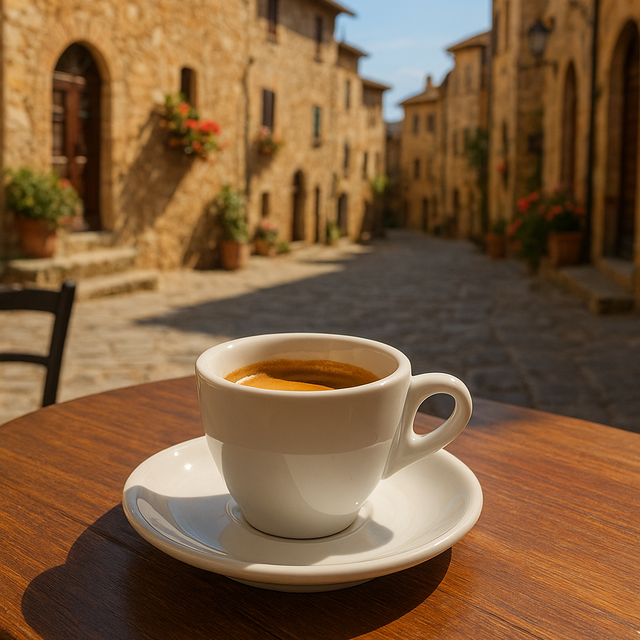
It is midday. The sun burns down on the rooftops of a small Tuscan village, the alleys are empty, and only the chorus of cicadas breaks the silence. An old man sits in the shade, slowly stirring his espresso. No phone, no noise — only time. Welcome to Italy. A country that knows that true happiness lies not in speed, but in rhythm.
This article is an invitation to rediscover the art of Italian living — between the midday heat and an espresso, between dolce far niente and deep enjoyment.
La Dolce Vita – More Than a Saying
La Dolce Vita — the sweet life — is not a cliché but an attitude. A philosophy that reveals itself not in luxury, but in consciously experiencing the everyday.
The first light of morning, the play of shadows across a piazza, the clinking of espresso cups at the bar — all of this is part of it. Just like the communal lunch, which in Italy is never rushed.
While elsewhere the day dissolves into appointments, here people follow a different rhythm: the rhythm of the sun, of food, of community. Maybe that is the real luxury of our time: slowness.
The Sacred Midday: Siesta as a Philosophy
Around 1 p.m., everything grows quiet. Shops close, shutters are drawn, and even bustling Rome or Florence takes a step back. The world slows down. This pausa pranzo is more than a lunch break. It is a social anchor. Families gather, friends meet, neighbours share stories over pasta and wine.
Afterwards comes a small siesta — not out of laziness but out of wisdom. The hot day demands retreat. The body rests, the mind breathes. Italy teaches us: not every hour needs to be filled.
The Espresso Afterwards – The Heart of Everyday Life
When midday fades, the second ritual of the day begins: the espresso. Short, strong, hot — but never casual. In every bar, in every village, this moment repeats itself. It is more than a drink: it is a brief pause from life, a place of connection, a piccolo lusso, a small luxury. It is consumed standing, at the counter, accompanied by a nod, a joke, a fleeting exchange. No to-go cups, no cardboard.
Espresso is transition. From lunch back to work. From thinking to feeling. From hurry back into the present moment.
Time as an Ingredient: The Art of Not Rushing Anything
Italy has a different relationship with time. What matters here is not how fast something happens, but how deeply it resonates. In the kitchen, this appears in the slow simmering of sauces left on the stove for hours. In the language — full of melody and gesture. And in the cities that invite wonder because they never impose themselves.
Chi va piano, va sano e va lontano, says an Italian proverb. Those who go slowly go safely — and far. Perhaps this is the true secret of La Dolce Vita: not doing more — but doing less, more consciously.
Places Where Time Stands Still
They do exist — places where you feel: the world can wait.
Civita di Bagnoregio, a village perched atop a cliff in Lazio, is accessible only via a footbridge. Hardly ten people live here. There are no cars, no noise. Only silence, light, and wind. When the evening sunbathes the tuff stone façades in gold, time seems to stop.
Pienza, the “ideal city” of the Renaissance, lies like a quiet jewel in Tuscany. The wide views over the Val d’Orcia, the stones of the piazza, the small cafés — everything breathes harmony. Beauty here is not an attraction but a way of being.
Matera in Basilicata is a marvel of stone. The ancient cave dwellings — the Sassi — tell of a time when living, earth, and history were one. At night, when lights illuminate the stone alleys, the city feels like a poem. A glass of wine there is more than pleasure — it’s meditation.
Holiday Homes That Breathe Slowness
An Italian holiday home is more than accommodation. It is a sanctuary. A stage for a simple, fulfilled life. A typical day there? Espresso on the terrace in the morning, the sun warming your skin. At midday, a visit to the market: tomatoes, basil, mozzarella. In the afternoon: a book, a shady spot, a conversation, or simply silence. In the evening: homemade pasta, a glass of red wine, a look at the starry sky.
Many holiday homes — from Tuscany to Umbria to Apulia — are designed to support exactly this rhythm. With natural pools, hammocks, thick stone walls, and gardens full of herbs. Time here is not an enemy, but a guest.
Between Espresso and Sunset: Small Rituals of Happiness
Italian art of living reveals itself not in large gestures but in small ones. In the way coffee is drunk: quick, strong, deliberate. In the midday rest, which is not silence but serenity. In the aperitivo, uniting evening ritual, meeting, music, and conversation.
These small rituals give the day structure — and life depth. They are like notes in a melody that doesn’t need to be loud to move you.
Slow Travel: Traveling with Meaning
Anyone who truly wants to experience Italy travels slowly. Not ten cities in five days, but one village that you get to know with all your senses. Slow Travel means market instead of supermarket. Train instead of highway. Conversation instead of selfie. Experiencing instead of ticking boxes.
A holiday home offers the perfect space for this. You stay instead of rushing. You become part of the surroundings. You know the barista by name, the neighbours greet you, and the scent of olive oil accompanies you through the day. Here, a vacation becomes a return — to yourself.
Food, Time and Love – The Trinity of Life
In Italy, food is not duty but an act of affection. When Nonna makes pasta, she does it not because she must — but because she loves. This interplay of time, care, and flavour is the quiet beauty of everyday life. At the table, everyone comes together. People eat, laugh, argue, remember, plan. Eating, drinking, talking — this is the real trinity of Italian life. And if you are lucky enough to experience this in a small house by the sea or between olive groves, you will understand time can be tasted.
Conclusion: When the Sun Stands Still
The Italian art of living teaches us: time is not currency. It is music. Those who spend it hastily hear only noise. Those who live it hear melody. Between midday heat and espresso lies the heart of the Italian soul. In pausing. In savouring. In letting go.
And perhaps that is exactly what the world needs today: less speed, more feeling.
Because sometimes the most beautiful thing you can do is nothing. Just be. With a cup of espresso in your hand and the sun on your face.