
- Winter Holiday In Italy: Fireside Warmth Instead Of Ski Lifts – How A Snowless Winter Can Be Magical
- From Olive Oil To Limoncello: Discovering Homemade Specialties
Holidays in the shadow of the etruscans – experiencing history in Tuscany
A profound, atmospheric, and inspiring blog post for anyone looking to turn their next trip into an unforgettable experience.
Where the past Comes alive
There are places in this world you don't simply visit – they take you in. Tuscany is one of those places. Amidst gentle hills, ancient olive trees, and vast vineyards lies a past far older than what we typically associate with the region. Long before Renaissance palaces were built and Chianti wines produced, a mysterious people lived here – the Etruscans – who continue to intrigue us to this day.
One of Europe’s most fascinating cultures
You may be traveling to Tuscany for its art, cuisine, or landscapes. But did you know that right beneath your feet – and often right before your eyes – one of Europe’s most captivating cultures still lingers? A civilization ahead of its time, whose traces can still be found in towns, names, traditions, and architecture. Join us on a journey to the world of the Etruscans – not as an academic lecture, but as an invitation to marvel. Discover places where history becomes tangible. And perhaps, by the end, you'll feel inspired to dedicate your next trip to the silent legacy of this ancient civilization.
Who were the Etruscans?
The Etruscans lived in central Italy as early as the 9th century BCE. They were traders, artists, architects, and bon vivants. Their cities stood proudly on hills – well-fortified and thoughtfully designed. Their tombs were magnificent, their rituals deeply meaningful. Even the Romans looked upon this enigmatic culture with admiration – and curiosity – adopting much from them. And yet, the Etruscans remain mysterious. Their language survives only in fragments, and their origins are still debated. It is this tension between knowledge and mystery that makes them so compelling. As if history had lifted a veil – but not fully.
Tuscany: Etruria beneath your feet
What we now call Tuscany was once Etruria – the Etruscans’ heartland. When you walk through towns like Volterra, Cortona, or Chiusi, you’re treading paths worn for thousands of years. But what makes this region so unique is that history here doesn’t feel like a museum exhibit or something dusty from the past. It’s in the air. In the stones. In the very shape of the land. You’ll encounter ancient city walls, underground burial chambers, and ruins tucked between vineyards. Not staged – simply present. Authentic, quiet, powerful.
Volterra: a place that moves you
Perched on a hill, Volterra immediately feels like a town that keeps its secrets with dignity. Particularly impressive is the Museo Etrusco Guarnacci – one of Europe’s oldest archaeological museums. Inside, you'll find intricately designed funerary urns, delicate grave goods, and the mysterious bronze statue Ombra della Sera, whose slender shape recalls modern sculpture. But even outside, Volterra tells its story. At Porta all'Arco, the ancient city gate adorned with distinctive stone faces, you can feel history watching, alive and alert. Volterra is not a town to rush through. It demands time – and rewards it with depth.
The Tuff stone world: Pitigliano, Sovana, and Sorano
In southern Tuscany lies a landscape that feels almost surreal. The towns of Pitigliano, Sovana, and Sorano rise dramatically from tuff cliffs, as if carved from the rock itself. Pitigliano is particularly striking, with its winding alleys and subterranean cave systems – much of it dating back to Etruscan times. Sovana, small and almost fairytale-like, surprises visitors with monumental tombs like the “Tomb of Ildebranda,” which resembles a stone-carved temple. Sorano, in contrast, is a maze of stairs, grottos, and hidden corners – a haven for explorers.
The Vie Cave: ancient paths with a special magic
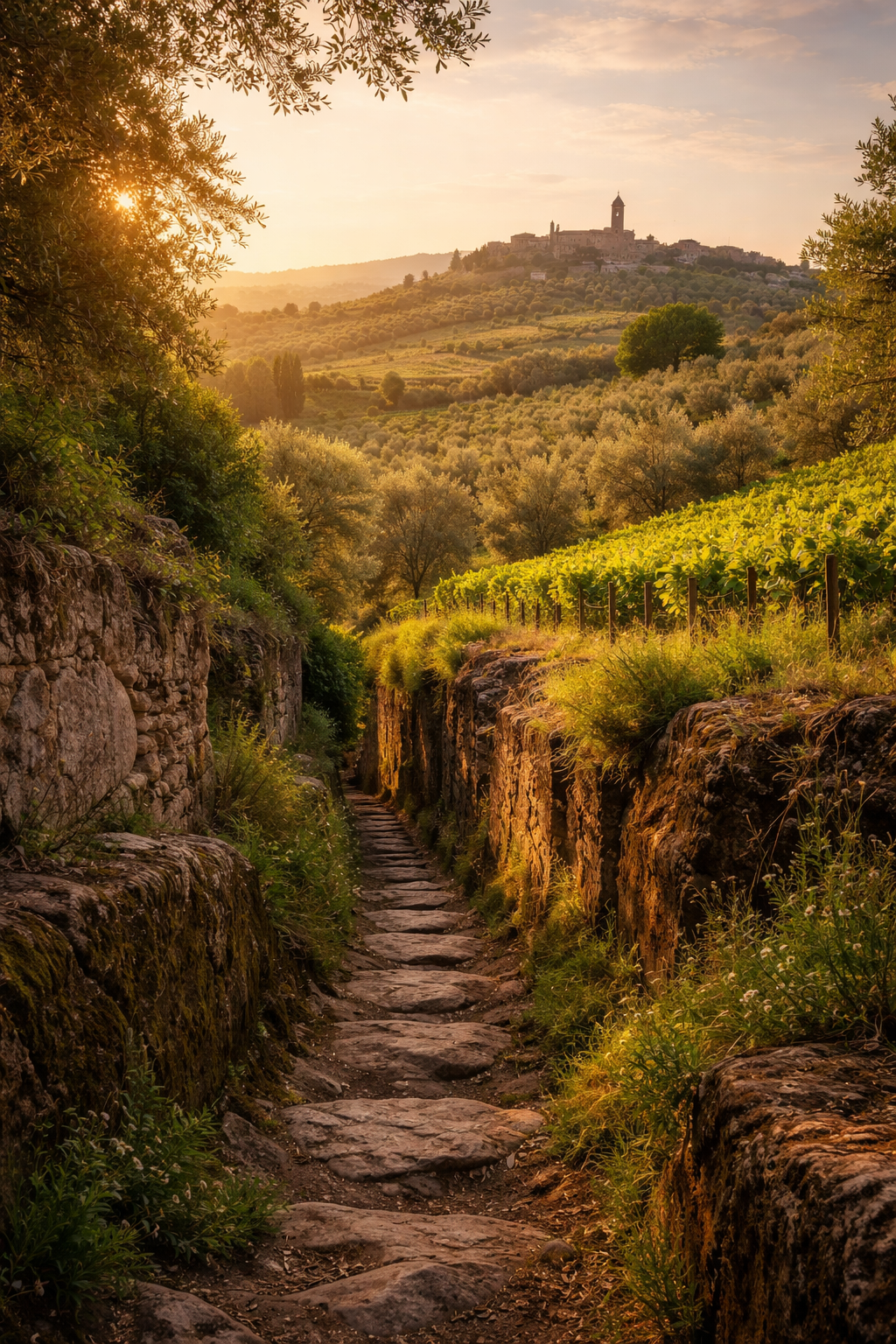
Connecting these towns are the so-called Vie Cave – mysterious hollowed-out roads cut deep into the rock. Walk here, surrounded by moss-covered walls with just a narrow strip of sky above, and you’ll feel it immediately: this is no ordinary hiking path. Many travellers describe their strolls through the Vie Cave as almost spiritual. It’s quiet, cool, sometimes damp. And yet there's a guiding presence – as if the land itself is telling a story. About impermanence. About connection. About what endures.
Cortona and Chiusi: cities with soul
Cortona is known for its beauty – and for its Etruscan legacy. At the Museo dell’Accademia Etrusca, you'll encounter original artifacts from the everyday life of a long-lost world. Just a few kilometers outside town lie the Meloni tombs – large burial mounds that watch over the land like stone guardians. Chiusi, on the other hand, was once among the most powerful Etruscan cities. King Lars Porsena – mentioned even by the Romans – is said to have ruled here. The Museo Nazionale Etrusco houses impressive finds, including access to the legendary Labyrinth of Porsenna – an underground network of tunnels that continues to fascinate.
Dining through history: cuisine then and now
A journey to Tuscany doesn't just touch the soul – it also delights the palate. The Etruscans loved game dishes, lentils, chickpeas, fine olive oil, and robust wine. Many of these traditions still thrive today. Try pecorino with truffle in Volterra, or Bianco di Pitigliano – a white wine steeped in history. And when you savour rustic game dishes in Maremma, you can almost taste the ancient roots of this cuisine.
Travel routes – at your own pace
You don’t need to be an archaeologist to experience the Etruscan world. Maybe start with a short loop: Volterra, Pitigliano, Sovana. Or take a deeper dive with stops in Cortona, Chiusi, and the Vie Cave. Food lovers won’t be disappointed either – a route through Maremma with culinary stops offers a feast for the senses.
A few practical tips
The best months to travel are April through June or September to October. The light is soft, nature is alive, and the trails are peaceful. Comfortable shoes are a must, especially in the Vie Cave. And don’t forget a light jacket – the old caves and tombs stay cool all year round.
More than a vacation: a connection to what unites us
You might return from this journey with more than beautiful pictures and memories. You might come back with a feeling – a sense of the depth of European history, and the harmony between nature, art, and the human spirit. The Etruscans were not just a lost civilization. They are part of our roots. When you walk the Vie Cave, stand before ancient gravestones, or hold an Etruscan artifact, you realize we're not so far apart after all.
Conclusion: seeing Tuscany anew – through Etruscan eyes
Tuscany isn’t just beautiful. It’s meaningful. And if you're ready to look beyond the postcard scenes, your journey will become something greater: an encounter with the past, with the land – and perhaps with a forgotten part of yourself.