
Ceramics from Montelupo Fiorentino: Tuscan craftsmanship you can touch
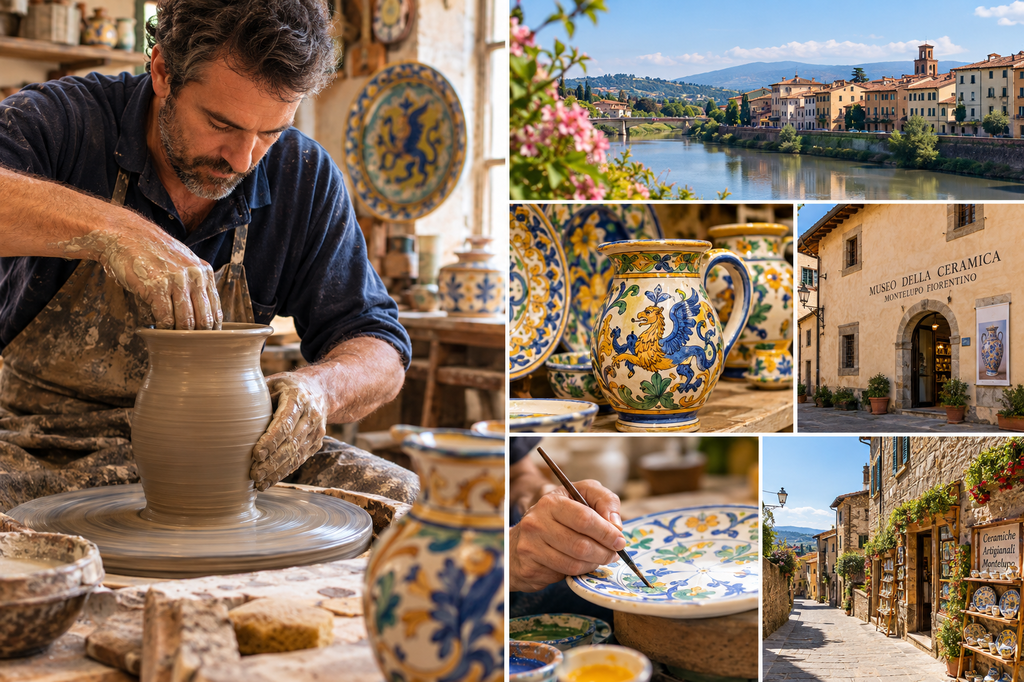
A typical morning in Montelupo Fiorentino. A man sits in his workshop, his hands buried deep in damp clay, whilst the shape of a jug slowly takes form beneath his fingers. Outside, along narrow alleyways, shelves full of painted plates, jugs and tiles line up behind shutters – blue, yellow, green, in patterns that have been passed down almost unchanged for over 600 years. This small village on the banks of the Arno is one of the most important centres of Italian ceramic art, though it has never achieved the widespread public appeal of better-known Tuscan destinations.
A tradition dating back to the Middle Ages
The story begins as early as the 14th century. Its location on the Arno, just a few kilometres from Florence, made the town an ideal trading hub: clay from the surrounding area, water for transport, and proximity to the prosperous city of the Medici. This gave rise to a ceramics industry that enjoyed a Europe-wide reputation even during the Renaissance. Florentine noble houses, led by the Medici themselves, sourced their tableware from the workshops of Montelupo.
Traditional majolica is characterised by bold colours – cobalt blue, ochre, yellow, deep green – and recurring motifs: griffins, lions, scrollwork, and geometric patterns with Arabic and Byzantine influences. This tradition remains alive to this day. Unlike in towns where craftsmanship is confined to museums, production still takes place here, rather than merely being on display.
The Museo della Ceramica
Anyone wishing to get an overview before visiting the workshops will find one of Italy’s most extensive collections of medieval and Renaissance ceramics at the Museo della Ceramica di Montelupo. Many of the pieces on display were found during archaeological excavations right here in the town – entire rubbish heaps from old workshops, preserved in the ground for centuries, now paint a complete picture of this art form. The museum is centrally located, so a stroll through the old town can easily be incorporated into your visit; another workshop awaits on almost every corner.
From clay to the finished piece
The process takes days, sometimes weeks. It begins with clay, often sourced locally, which is left to settle for weeks to achieve the right consistency. The basic shape is formed on the potter’s wheel and must be left to dry for several days before being fired in a bisque firing at around 950 to 1,000 degrees.
Then the real art begins: the painting. A white base glaze is first applied to the still-porous surface, onto which the colours are painted freehand – many of the traditional patterns are still created today without a stencil, relying solely on decades of practice. It is only the second firing, at lower temperatures, that causes the glaze and pigments to fuse into the glossy surface that characterises Montelupo ceramics.
This two-stage process explains why handmade pieces are significantly more expensive than mass-produced industrial goods: each plate undergoes the entire process individually, with all the irregularities that genuine handiwork entails – and which collectors particularly value.
Try your hand at the potter’s wheel
Numerous workshops offer their own courses. Under the guidance of experienced craftspeople, you can learn the basics of the potter’s wheel in one to two hours or paint pre-formed blanks using traditional patterns. For families, this often becomes the highlight of their entire stay in Tuscany – the joy of creating your own, slightly lopsided piece is hard to put into words. A morning like this is particularly well suited to one of the few rainy days that even the Tuscan spring or autumn brings.
You can hear the steady whirring of the wheel, smell the damp, earthy clay, and, as you try your hand at it, feel just how much finesse is needed to shape a simple bowl into a reasonably even form. Many visitors later report that it was precisely this sensory, almost meditative moment that left one of the most lasting impressions of their entire trip – regardless of how skilfully crafted their own creation turned out in the end.
Workshops with a multifaceted character
Today, several dozen workshops are still in operation, ranging from small family businesses to studios exhibiting internationally. Some specialise in the faithful reconstruction of medieval patterns and work closely with the museum. Others deliberately break with the classical aesthetic, employing reduced colour palettes, unusual shapes and contemporary design.
It’s well worth taking a tour of several workshops, as styles and price levels can vary considerably. Some owners are now in their fourth or fifth generation of running the business, which lends conversations about the craft a personal touch rarely found in major tourist centres.
What you really should take home
Hand-painted originals can be recognised by slight irregularities in the painting and by a signature or workshop stamp on the underside, which are almost always present on genuine pieces. Industrially printed goods, such as those increasingly found in tourist shops, often appear too flawlessly uniform – a sign that a machine was at work here, not a human hand.
For delivery to your home, most established workshops offer professional, shatterproof packaging, sometimes including international postage. This is a sensible option for bulky or fragile items such as jugs or tile sets, rather than risking the fragile contents in your own suitcase.
Why Montelupo matters in art history
The majolica technique, in which zinc oxide gives the glaze its characteristic opaque white base, originally reached Italy via the Arab Spanish world. In Renaissance Tuscany, it found one of its most significant centres of development in Europe. Montelupo occupies a special place in this context because, for centuries, production here was not limited to meeting local demand: Finds of Montelupo ceramics have been unearthed in excavations as far afield as Northern Europe and the eastern Mediterranean.
Art historians therefore count the town amongst the key centres of European ceramic history, even though, in terms of tourism, it is nowhere near as well-known as one might expect given its significance. For travellers seeking authentic craftsmanship away from the crowds, this is precisely the appeal.
Other places, other materials
Montelupo may be the best-known centre, but it is not the only one. Impruneta, south of Florence, is synonymous with terracotta – the characteristic red pots, roof tiles and floor tiles found in almost every Tuscan garden traditionally come from here.
Pietrasanta on the Versilia coast is a vibrant town of sculptors, shaped by its proximity to the marble quarries of Carrara. In Certaldo Alto, the medieval town centre, small workshops combine traditional craftsmanship with contemporary design.
Open all year round – with a highlight in June
Unlike the grape or olive harvests, the arts and crafts in Montelupo are accessible all year round. June traditionally sees the Festa Internazionale della Ceramica, a festival lasting several days during which the historic town centre is transformed into a public workshop stage, featuring live demonstrations, music and nightly fireworks over the Arno. If you can fit this event into your schedule, you’ll experience the town at its liveliest – though a visit outside this period remains the quieter, and for many, more authentic alternative.
The perfect starting point
Montelupo Fiorentino lies between Florence and the Chianti region, making it ideal for a day trip from numerous holiday homes in the surrounding area. From Chianti or the Val di Pesa, the workshops can usually be reached in under 30 minutes. That’s close enough for a spontaneous afternoon out, yet far enough away to return to the tranquillity of the hilly countryside in the evening.
The town can also be easily incorporated into a day trip from the Versilia coast or the Garfagnana, particularly if you take the motorway on the return journey. In this way, a single day combines several facets of Tuscany: a morning in the pottery workshop, an afternoon strolling through Florence, and an evening back in the tranquillity of the country house.
Frequently asked questions about ceramics from Montelupo Fiorentino
Why is Montelupo Fiorentino famous for its ceramics?
The town has a tradition dating back to the 14th century. Thanks to its location on the River Arno and its proximity to Florence, it once even supplied the Medici family.
Can you try your hand at pottery in Montelupo?
Yes, numerous workshops offer courses, ranging from the traditional potter’s wheel to painting pre-made pieces.
What does the Museo della Ceramica display?
An extensive collection of medieval and Renaissance ceramics; many pieces come from excavations carried out right in the town itself.
How far is Montelupo from Florence?
Around 20 kilometres south-west, about 30 minutes by car.
Which other places in Tuscany are known for their arts and crafts?
Impruneta for terracotta, Pietrasanta for sculpture, and Certaldo Alto for small studios.
A holiday home between Florence and Chianti opens the door to a Tuscany where centuries-old crafts can still be experienced first-hand today. ItalicaRentals helps you find the perfect base for this journey of discovery.