
Travelling to Italy in an electric car: holiday homes, charging networks and travel planning
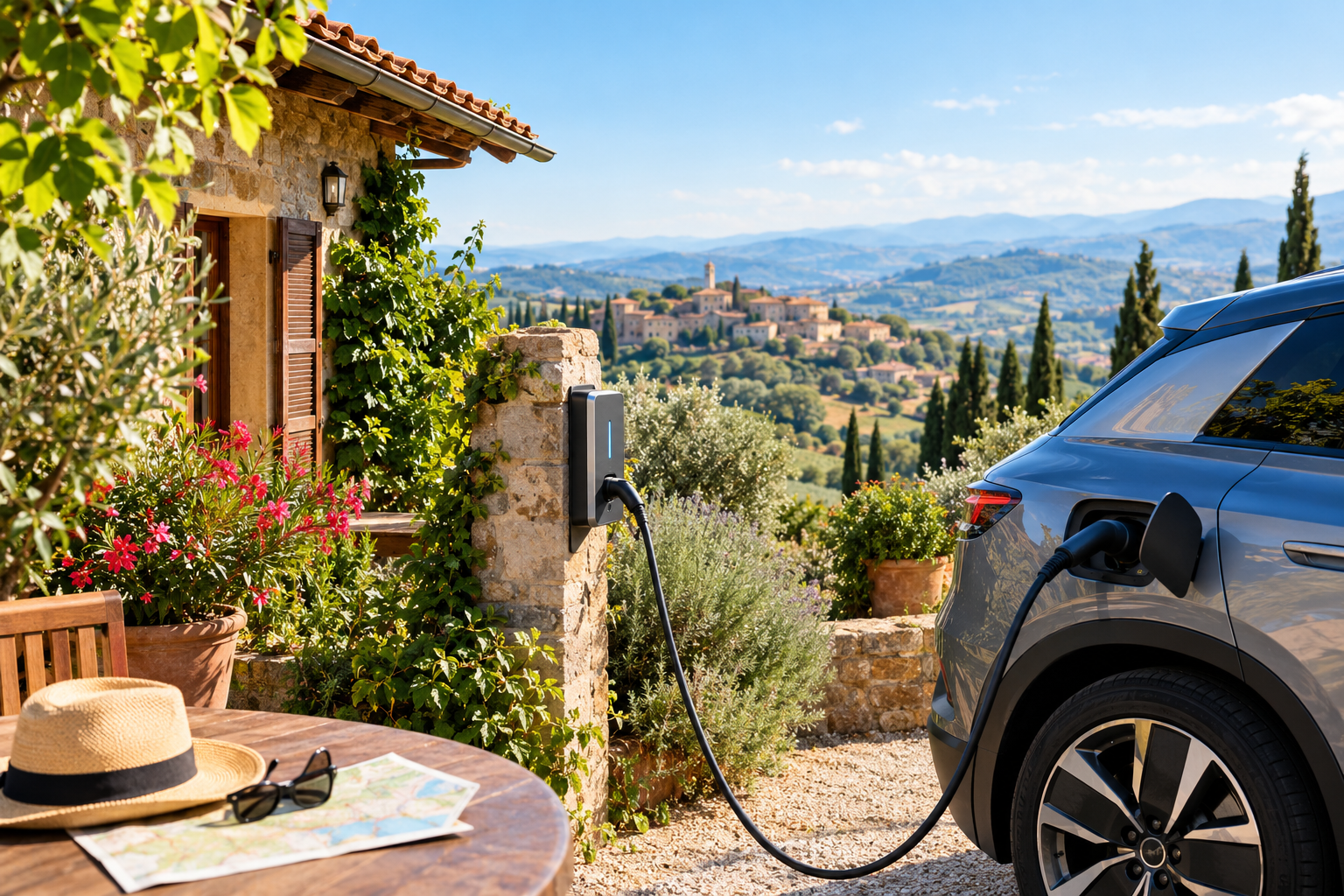
Does this sound familiar? You’re planning a holiday in Italy, and whilst looking at the photos of the terrace at your holiday home, you’re already half in love with it – and then suddenly this one question pops into your head: can we actually get there in an electric car, and what do we do if the battery runs out and the nearest village is three bends away? First, the good news: Italy has long been a great place to travel around in an electric car. The interesting news is something else entirely, and it comes as a surprise to most people: it’s not your car’s range that determines whether you’ll have a relaxing holiday, but a rather unassuming question when searching for a holiday home – is there a wall box there or not?
A look at the figures shows why this is so crucial. By the end of 2025, there were over 70,000 public charging points in Italy. That sounds like a lot, and it is – but the distribution isn’t even across the country. Around 61 per cent of them are in the north, about 20 per cent in the centre, with the rest spread across the south and the islands. So, if you’re driving from Milan to Bologna, you probably won’t notice a thing. But if you book a holiday home in a quiet corner of Puglia or on Sardinia, you should investigate the charging situation in a bit more detail beforehand. That’s exactly what this is all about: first, finding the right accommodation; then, the journey there; and finally, the pitfalls of Italian city centres.
What’s the actual state of the charging network in Italy?
Frankly speaking, northern Italy is no longer a major challenge. Lombardy, Piedmont, Veneto and Emilia-Romagna are among the regions with the densest charging infrastructure in Europe. On the wide-open motorways – the A1 from Milan via Bologna, Florence and Rome to Naples, or the A4 cutting across the north – the number of fast-charging points is growing noticeably. Nevertheless: never rely on just one service station when you’re on the road. Charging points may be occupied, faulty or temporarily out of service, so it’s a good idea to have an alternative in mind.
The further you stray from the main routes in Tuscany and Umbria, the sparser the network becomes – it’s satisfactory in the towns and along the major roads, but rather patchy in the countryside. This is precisely where we can already see what will be discussed more often later: a holiday home with its own charging facilities makes all the difference in such regions. The situation is similar in the Marche, Abruzzo and Basilicata, as well as in Apulia and Calabria, where the major coastal resorts are significantly better served than the rural hinterland. In Sicily and Sardinia, on the other hand, a stay in one fixed location with a holiday home that has charging facilities is almost always more worthwhile than a spontaneous road trip across the island. And in the Alps or the Dolomites, there is another factor to consider alongside the infrastructure: altitude reduces range, no matter how well the nearest charging point is signposted.
When it comes to operators, there’s no need to get bogged down in the details – a few names are enough to find your way around. Enel X Way and Plenitude Be Charge are the major Italian players with a dense network in cities. Free To X operates fast-charging hubs directly on motorways and, in some cases, at airports, with charging capacities of up to 300 kW – which is certainly handy for long journeys. Ionity and Tesla Superchargers are mainly found on international long-distance routes, with the latter being particularly relevant for Tesla drivers. And away from the main routes, regional providers such as A2A or Alperia pop up time and again – unassuming, but when in doubt, they can be just the lifeline you need when the well-known names aren’t available.
What really matters: the holiday home with a charging option
Here’s the point that’s far too often overlooked when planning. Everyone talks about charging networks, apps and range – yet the convenience of an electric car holiday is usually decided the moment you book the house. Having a wallbox on site means your car charges overnight, whilst you’re asleep or enjoying another glass of wine on the terrace. The next morning, the battery is fully charged, without having to make a detour to a charging point. Public chargers thus become the exception rather than a daily chore – and even a house in the middle of nowhere suddenly becomes a realistic option again.
The only problem is: ‘Charging facilities available’ appears in many adverts, without anyone having asked exactly what that means. That’s why it’s worth going through a short but specific list of questions before booking:
- Is there actually a wall box, or are they just referring to a standard socket somewhere?
- What is its charging power – 3.7 kW, 7.4 kW, 11 kW or more? This is precisely what makes the difference between a full night’s charge and half a night.
- Is charging explicitly permitted – ideally confirmed in writing? Verbal assurances are quickly forgotten once you’re there.
- What type of plug is required – usually Type 2, but it doesn’t hurt to bring your own cable anyway.
- Do you have exclusive use of the parking space, or do you share it with other guests?
- How is billing handled: a flat rate, based on consumption, or via a dedicated meter?
- And is there even a public alternative nearby, in case something does go wrong?
A reputable property description would read something like this: “Private parking space with a Type 2 wall box, up to 11 kW, charging by arrangement and billing based on consumption – bringing your own charging cable is recommended.” It sounds technical – and it is – but it’s precisely these details that make the difference between a relaxing stay and a week spent constantly checking your battery level. Phrases such as ‘electric car-friendly’ or ‘power connection available’, on the other hand, should be taken with a pinch of salt – they sound good, but they mean practically nothing.
One more point about standard domestic sockets, as they’re a frequent source of confusion: in an emergency, they can be used for very slow charging, but only if the installation and circuit protection are actually suitable for this – and that’s by no means a given with just any outdoor socket. If in doubt, it’s better to ask once too often than to find yourself at your holiday destination facing a socket that nobody really wants to let you use.
The journey: How to arrive feeling truly relaxed
From Germany, the route usually takes you via Austria or Switzerland to northern Italy, and which route best depends on your starting point, vehicle and the time of year. However, one rule of thumb applies practically always, no matter where you start: never arrive at your planned charging stop with just 5 per cent battery remaining. That may sound obvious, but it can quickly become a problem – especially on busy holiday Saturdays, when there’s a headwind or on long mountain stretches – if the charging point, you’d planned to use is suddenly occupied.
In practical terms, this means don’t just check intermediate charging points on your car’s sat-nav, but also on a second, independent app – the two often show surprisingly different information. For every longer stretch of the journey, come up with an alternative straight away in case your first choice doesn’t work out. And on busy days, it’s almost always wiser to recharge a little earlier rather than hoping for the supposedly optimal next stop. On long journeys, fast chargers are worth using; at your holiday home, a leisurely overnight charge is usually sufficient. If you arrive at accommodation without its own charging facilities, it’s better to plan for a battery level of 40 to 60 per cent – rather than hoping to make it to the next morning with an empty battery.
Regarding tolls: most Italian motorways are subject to tolls, regardless of the vehicle’s powertrain. On the Autostrade per l’Italia network, you take a ticket at the entrance and pay at the exit; at lanes marked in blue, you can also pay conveniently by card – Visa, Mastercard, American Express and a few others work without any problems. The yellow Telepass lanes, on the other hand, are only intended for vehicles with a compatible toll device; if you don’t have the device, it’s best to head straight for the card lane and keep your entry ticket safe, otherwise it will be unnecessarily stressful at the exit.
When it comes to payment cards and apps, I’d advise you not to rely on a single solution. A Europe-wide payment card or a roaming provider is recommended, along with at least one operator app widely used in Italy. You should also have a contactless credit or debit card, and ideally a second one as a backup. This – along with at least one operator app widely used in Italy and a contactless credit or debit card – is by no means an excessive precaution. Ideally, you should have a second card as a backup. That’s a contactless credit or debit card, and ideally a second one as a backup – this isn’t an excessive precaution, but simply practical in case an app fails. Since the EU’s AFIR regulation came into force, new fast-charging points with a capacity of 50 kW or more must accept card payments; at smaller charging points, a QR code is still sufficient in some places. However, don’t blindly rely on every older AC charging point offering this option.
And then there’s the weather and the landscape, which have a greater impact on energy consumption than you might initially think. In the Alps or the Apennines, every uphill stretch noticeably drains the battery – regenerative braking on the descent partly makes up for this, but only once you’ve completed the climb, not before. In the height of summer, the air conditioning guzzles power in traffic jams; in winter, it’s the heating that does the same. And anyone heading to the coast in July or August should expect traffic jams on travelling days – and therefore also unplanned charging stops. A small but important side note: on narrow village roads, it’s not just about range, but simply about getting through. Checking in advance whether your holiday home is even accessible with a larger vehicle will save you a fair bit of manoeuvring.
City traffic and the issue of ZTL zones
An electric car doesn’t automatically open every door in Italian cities. Many city centres have a so-called ZTL – Zona a Traffico Limitato – a camera-monitored zone with restricted access. Some cities make exceptions for electric cars, but often only with prior registration of the number plate; others treat all vehicles equally, regardless of their power source. In Palermo, for example, electric cars are exempt from the ZTL charge, whilst in Rome, Florence or Bologna, specific rules apply depending on the zone. There is therefore no nationwide – or rather, regional – free pass for electric vehicles, which is precisely why you shouldn’t blindly follow your sat-nav into an old town.
What helps in practice: choose a holiday home outside the old town or one with a guaranteed parking space, if possible. If your accommodation is within a ZTL, it’s worth asking your hosts specifically whether and how you need to register your number plate – and then make sure you have this confirmation with you. Blindly trusting your sat-nav when it suggests the ‘shortest route’ or ‘avoid toll roads’ is also not a good idea, as such settings often lead right through the narrow centres of villages. Ultimately, it’s the local road signs that matter, not the app.
Which regions are particularly suitable
If you summarise all this, a ranking almost emerges of its own accord. Northern Italy, Emilia-Romagna and the extensive motorway networks are the most straightforward choice for a first electric car holiday in Italy – short distances between charging points, little preparation required. Tuscany and Umbria work well if the holiday home has a confirmed wall box; without one, options in the countryside quickly become more limited. And the south – Sicily, Sardinia, Puglia, Calabria – can also be explored at a leisurely pace, though it requires a bit more initiative when it comes to planning. This is precisely where the main point of this whole article becomes most apparent: it’s not the country that determines whether your holiday will be stress-free, but the holiday home you end up booking.
Frequently Asked Questions
Is it easy to drive to Italy in an electric car?
Yes, especially on the extensive motorway network. There were over 70,000 public charging points by the end of 2025 – though they are very unevenly distributed between the north and south. In rural areas, it’s therefore worth ensuring there’s a confirmed charging facility right at your holiday home.
Which app do you need for charging in Italy?
There isn’t a single app that covers everything. The most practical approach is a combination: a Europe-wide charging card or a roaming provider, plus at least one Italian operator’s app and a contactless credit or debit card for spontaneous charging.
Can I simply charge my car from a standard socket at my holiday home?
Only if the hosts expressly allow it and the installation is suitable for this purpose. A wall box lööis generally the safer option – I’d be cautious about using just any outdoor socket.
Do I need my own charging cable?
For AC charging points and wall boxes, it’s a good idea to have your own Type 2 cable. At DC fast chargers, the cable is usually fixed to the charging point. It’s best to check beforehand what your car supports.
Are there fast chargers on the motorways?
Yes, amongst others, Free To X operates hubs with up to 300 kW directly on Italian motorways. Even so: it’s better to plan rather than rely on everything being free at the next service station.
Do you still have to pay tolls with an electric car?
Yes, of course – the toll system makes no distinction between combustion-engine and electric vehicles. Payment with standard cards works without any problems at the relevant lanes operated by Autostrade per l’Italia.
Are electric cars allowed to drive in ZTL zones?
It depends entirely on the city. Some make exceptions, usually subject to prior registration, whilst others do not. Checking the specific regulations before entering will save you an expensive fine if in doubt.
Is an electric car suitable for a round trip through Sicily or Sardinia?
Yes, provided the route isn’t planned to be too demanding. Major towns and main roads are well catered for, whilst remote coves and the island’s interior are less so. The most stress-free way to travel is with a wall box at your holiday home as a fixed charging point.
Conclusion
In the end, one simple conclusion remains: over 70,000 charging points sounds impressive, and you do notice them on the more extensive routes. But whether your holiday will truly be relaxing isn’t determined by the total number of charging points in the country, but by a single question you should ask when booking: Does this holiday home have a working, confirmed charging facility? Once that’s sorted, the rest – route, tolls, restricted traffic zones – becomes surprisingly uneventful.