
- When Should You Book A Holiday Home In Italy?
- A Holiday Home Or A Hotel In Italy – Which Is Worth It?
Driving in Italy in 2026 – An overview of tolls, ZTLs, parking and fines
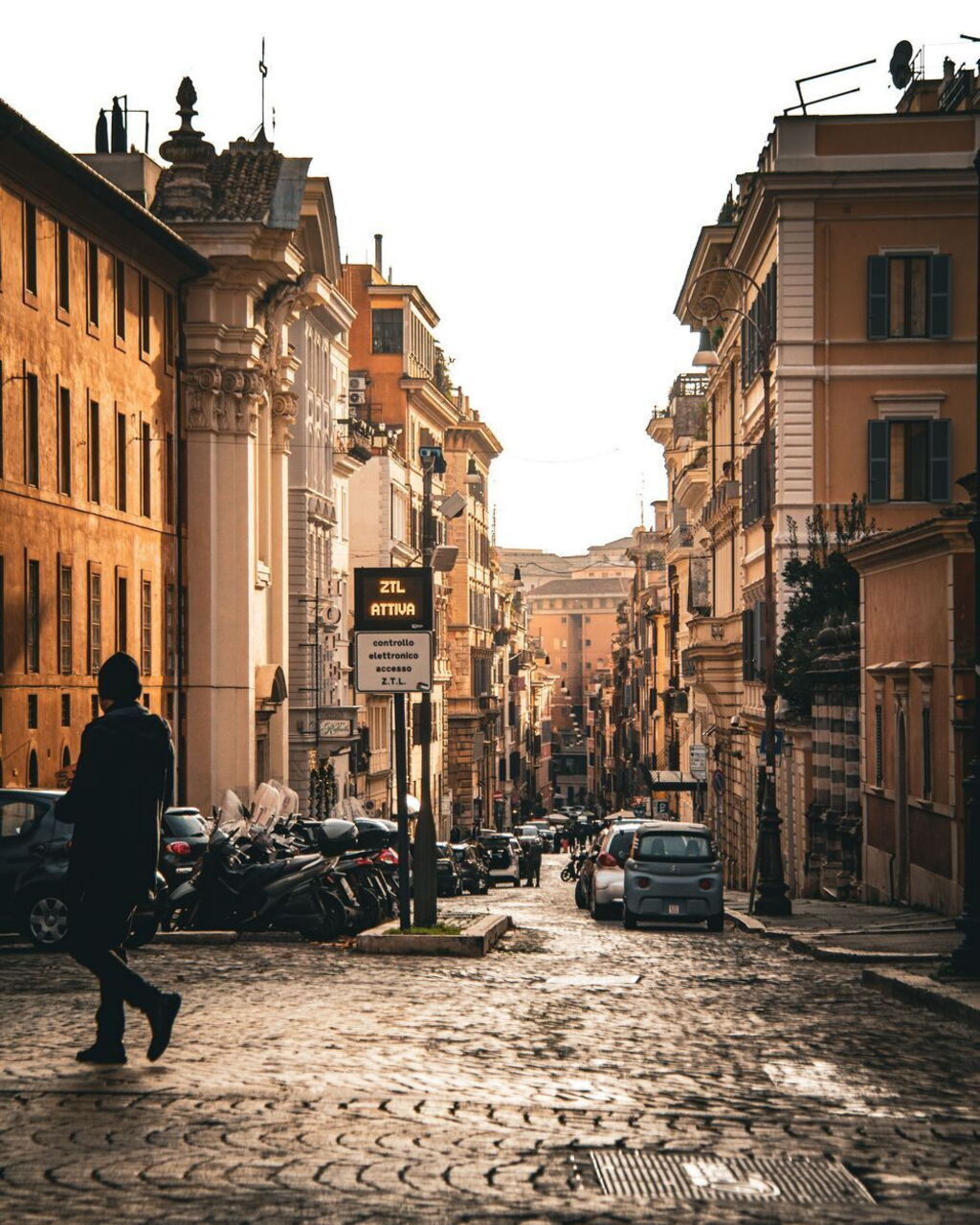
Italy has its own traffic regulations, a toll system and a system for issuing fines, and these differ significantly from those in Germany in several respects. This is no cause for concern, but it is a good reason to familiarise yourself with the rules beforehand. If you know the key rules, you’ll have no trouble driving through the country. Those who don’t know them risk receiving fines, some of which may not arrive in your letterbox until months after your return and are enforceable in Germany as well. Here is the complete overview for 2026.
Speed limits and traffic rules
The basic limits are easy to remember: 50 km/h in built-up areas, 90 km/h outside built-up areas, 110 km/h on expressways and 130 km/h on motorways, unless signposted otherwise. In wet conditions, these limits are automatically reduced – to 110 km/h on motorways and to 90 km/h on expressways. This applies regardless of whether it is raining or the road is simply wet.
Italy is stricter on drink-driving than many expect: the legal limit is 0.5 per mille; for new drivers in their first three years and for anyone under 21, however, the limit is zero. Outside built-up areas and on motorways, you must drive with your headlights on even during the day – a rule that is treated more leniently in Germany and is therefore easily forgotten. And if you’re carrying a speed camera detector, you should leave it at home: it’s banned and can cost up to 800 euros.
Speeding offences themselves can quickly become expensive. Exceeding the speed limit by 20 km/h or more will cost you at least around 175 euros; exceeding it by 50 km/h or more increases the fine to at least around 545 euros. Additional penalties are often imposed as well.
ZTL zones: the most common costly trap
Hardly any other issue causes as much confusion amongst motorists in Italy as the ZTL, short for “zona a traffico limitato”. These are restricted traffic zones found in almost every major city, particularly in the historic centres of Rome, Florence, Milan and Bologna. As a rule, only residents, delivery vehicles and vehicles with special permits are allowed to enter. The tricky bit is that the signage is often small, the restricted times vary, and cameras sometimes record your entry without you even realising it.
Anyone entering without authorisation faces a fine of around 100 euros per offence – each individual entry is counted separately. So, if you drive through the same zone several times whilst looking for a parking space, you could end up with several fines in a single afternoon. If you then park unauthorised within the ZTL, you’ll also have to pay at least around 42 euros plus administrative costs.
What’s particularly annoying is that these fines often don’t arrive until months later, as processing in Italy takes time. The ADAC and German consumer advice centres expressly point out that Italian fines remain enforceable in Germany for five years. So anyone who thinks a parking fine from Florence will simply lapse if they ignore it is usually mistaken. The safest option is to check the ZTL zones for your planned destinations online before your trip and, if in doubt, simply park outside them.
Tolls: Distance-based tolls and Free-Flow
Unlike in Germany, on Italian motorways you almost always pay distance-based tolls, calculated according to the number of kilometres travelled and the vehicle class. For a car, this averages around 7 cents per kilometre, which really adds up on longer journeys.
With the traditional system, you take a ticket at the entrance and pay at the exit by card, cash or Telepass. A newer system is the free-flow system, which is now in use on routes such as the A36, A59 and A60. There are no longer any traditional toll stations on these routes; cameras automatically record the number plate, and payment must then be made within 15 days, usually online or at a service point. Anyone who overlooks this risks receiving additional charges, some of which may not arrive until years later.
Losing a ticket can also prove costly, as without proof of the actual entry point, the longest possible route is charged upon exit. For popular holiday routes, it’s worth having a rough idea of the costs: from the Brenner Pass to Lake Garda or on to Rome, toll charges range from around 15 to just under 60 euros, depending on the route. If you want to save money, there are toll-free sections on parts of the A2 between Salerno and Reggio Calabria, as well as on some Sicilian motorways such as the A19 and A29.
Parking: understanding the colour codes
Anyone parking in Italy should, above all, be familiar with the colour codes at the roadside. White lines usually indicate free parking, provided no additional sign states otherwise. Blue lines mark paid parking spaces, for which you must purchase a ticket from a pay-and-display machine or via an app. yellow lines are reserved for buses, taxis or residents with special permits, and kerbs marked in black and yellow simply mean: no stopping whatsoever.
Anyone who parks illegally outside a ZTL will be fined between around 40 and 45 euros, depending on the city. Within a ZTL, the parking fine of at least 42 euros is compounded by a fine for unauthorised entry – a double blow that can quickly become expensive.
A separate rule applies to electric car drivers: parking spaces with charging points may only be used whilst the vehicle is being charged. Anyone who simply parks there risks a fine of up to 87 euros.
Travelling through Italy in an electric car
There are big changes on the horizon for electric car travellers in 2026. The EU stipulates that, in future, fast-charging stations with a capacity of at least 400 kW – rising to 600 kW by 2028 – must be available approximately every 60 kilometres along the major motorways. Incidentally, even more ambitious targets apply to lorries and buses, with stations every 120 kilometres and charging capacities of up to 2,800 kW. In practical terms, this means that Italy is significantly expanding its charging network along the main routes, and the chances of finding a free fast charger whilst on the road will increase considerably by 2026. Nevertheless, the parking rule at charging points mentioned above still applies.
Roundabouts and driving style
The rules at roundabouts are like those in most EU countries: drivers already on the roundabout generally have right of way, provided the signage indicates this. Nevertheless, it’s worth exercising a little more caution than you would at home, as the driving style of many Italian motorists is generally considered to be more spirited.
A small but important difference: you must use your indicator when exiting a roundabout, but not usually when entering one. And if you’re driving on multi-lane roundabouts, you should expect spontaneous lane changes, which aren’t always signalled in advance.
What to keep in the car
A high-visibility vest is compulsory for every person leaving the vehicle in the event of a breakdown or accident outside built-up areas – and this applies to each person individually, not just one for the whole car. A warning triangle and a first-aid kit are also part of the basic equipment.
As for documents, your driving licence, vehicle registration certificate and proof of insurance should always be to hand; the Green Card is recommended. With hire cars, it’s worth carrying the hire agreement and the hire company’s contact details, particularly when it comes to ZTL permits, which sometimes must be applied for through the hire company. And even though, strictly speaking, it is not a traffic rule: the European Health Insurance Card and international health insurance should be kept in the glove compartment.
An overview of fines
|
Offence |
Fine |
|
Entering a ZTL without authorisation |
fines from around €100 per offence |
|
Speeding by 20 km/h or more |
costs at least €175 |
|
Speeding by 50 km/h or more |
from approx. 545 €, sometimes accompanied by a driving ban and penalty points |
|
Drink-driving |
from approx. 545 €; significantly more severe penalties apply for higher blood alcohol levels |
|
Illegal parking outside the ZTL |
costs around 40–45 € |
|
Parking at a charging point without charging |
up to 87 € |
|
Use of a speed camera detector |
up to €800 |
All these fines are enforceable within five years, including in Germany.
Refuelling: handy practical tips
Petrol stations are well distributed along the main roads and around towns; those on motorways are often even open round the clock. Payment is usually by card or cash; self-service and full-service pumps are often side by side, so it’s worth checking the signage before pulling up at the wrong one.
If you know the terms, it’s easier: diesel is called ‘gasolio’, regular petrol ‘benzina’, and unleaded premium usually ‘senza piombo’. And a simple money-saving tip to finish with: prices at motorway petrol stations are noticeably higher than in towns and villages. If you have the chance to fill up off the motorway, you’ll usually pay significantly less.
With these basic rules in mind, your 2026 road trip through Italy will be a pure pleasure, from the Brenner Pass to Calabria, with no nasty surprises waiting in your letterbox.