
- Enjoying Summer In Italy – Without The Heat, Hustle, And Mass Tourism
- The Ideal Holiday Apartment For Beginners In Versilia: Where Is Your Dream House Located?
Sustainable travel in Italy – consciously, relaxed, and without compromise
Why sustainability in an Italian vacation is often easier than you think
Sustainable travel is a term that has gained significant popularity in recent years. It represents the attempt to combine environmental protection, social responsibility, and personal travel enthusiasm. But as justified as the desire for environmentally conscious travel is, it can quickly become a burden in practice. Many travellers do not perceive sustainability as a relief, but rather as a pressure of expectations. Instead of relaxation, a feeling of restriction arises: You shouldn't do this, you can't do that, and you should be much more consistent.
Especially during vacations, which promise the opposite of deprivation, this contradiction becomes noticeable. The concern about not travelling sustainably enough gets in the way of actual relaxation. And yet, sustainable vacation does not have to be a compromise. Those who choose Italy as a travel destination will encounter structures in many ways that facilitate sustainable behaviour—not because they are adorned with green labels, but because they are historically, culturally, and geographically oriented towards resource conservation. Sustainability here is less a trend than a byproduct of established ways of life.
Sustainability does not begin with renunciation, but with attitude
A common misconception is that sustainable travel is all about consistency. It's not about optimising every decision, but about setting the right priorities. In Italy, you come across many situations that facilitate sustainable behaviour without making it a moral project. Precisely because much of it has arisen from pragmatism rather than ideology, it feels less demanding.
For example, short distances between accommodation, shopping, and leisure activities in many Italian cities and villages are not marketed as a sustainable achievement. They are simply there – because it has always been that way. This casual functioning is often more effective than elaborately staged concepts.
Practical structures instead of sustainable labels
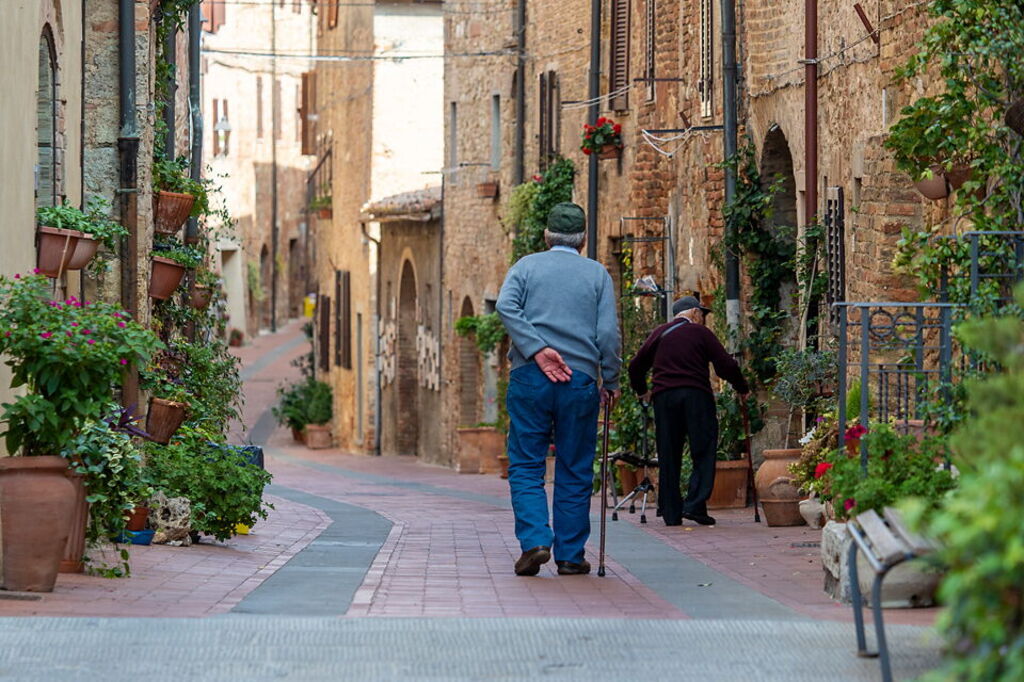
In many Italian places, essential needs are located close to each other. You can reach the baker on foot, the market around the corner, the bar in the square, and the restaurant two alleys away. This density not only reduces car traffic but also changes the travel experience. One goes from being a consumer to being a participant.
Travellers who embrace this rhythm experience their vacation differently. The daily routine takes precedence over scheduled activities. Arriving is more important than relocating. Sustainability is achieved here not through planning, but through habit – one that guests almost automatically fall into.
Without much ado: regional cuisine
Another aspect related to sustainable travel culture is nutrition. In Italy, regional cuisine is based on the local products of the area. Most ingredients come from the neighbourhood. It is based on the seasons, what is available, and regional identity. What is marketed elsewhere as "Farm to Table" or "Slow Food" is part of everyday life here.
Focusing on the nearby does not mean having less enjoyment, but more connection to the surroundings. In Puglia, you get something different at lunchtime than in Emilia-Romagna. The differences are felt in culinary and cultural terms. Here, sustainability is characterised not by restriction, but by diversity.
Architecture, climate, and building culture: sustainability in existing structures
Many holiday accommodations in Italy are in historic buildings. Instead of new buildings, guest rooms are being created in former farmhouses, city apartments in palaces, or accommodations in monasteries. These buildings were not built for tourism, but for life in the area. That's exactly what makes them appeal – and gives them sustainable value.
Massive walls, small windows, shady courtyards, and thick roofs create a pleasant indoor climate without air conditioning. They adapt to the region and blend into their surroundings. Those who live in such houses do not automatically consume less energy, but they live more consciously in the context of the place. And that is often the more effective contribution.
Less speed, more presence
Italy does not force you to slow down, but it suggests it. The routines of everyday life follow different patterns: shops close in the afternoon, life shifts to the evening, meals take time. Those coming from a highly scheduled environment initially find this unusual. But soon a new sense of travel emerges – less driven, less goal-oriented, but more attentive. This deceleration has sustainable effects. It reduces mobility pressure, avoids hustle and bustle, and enables encounters. Those who do not rush from place to place, but linger, consume less and experience more. Sustainability arises from time, not from speed.
The public space as a common good
In many Italian places, public space is not just a transit area, but a place to stay. People sit in squares, stroll along promenades, filling the space with conversations, observations, and community. This use reduces the pressure to consume. You don't need an admission ticket, any entertainment, or a program. For travellers, this means relaxation without effort. The atmosphere makes the day special. The space is open, not closed. And thus, more ecologically and socially sustainable than any air-conditioned experience world.
Everyday life Instead of attraction: how sustainability arises casually
A typical misunderstanding about sustainable travel is that you must give up something. Less comfort, less mobility, less choice. In Italy, a different path emerges: Less as a conscious limitation, not as a lack. A smaller food selection does not mean less enjoyment, but rather less waste. An accommodation without a pool is not inferior, but naturally integrated. A place without an event calendar allows for self-initiative. These forms of reduction relieve both the environment and the travellers themselves.
Longer stays instead of constantly changing locations
An often-underestimated aspect of sustainable travel is the duration. Those who stay longer in one place travel more calmly, cause less traffic, and integrate more. Italy is particularly suitable for this because everyday life and vacation often merge into one. Instead of ticking off tourist attractions, the ordinary becomes an experience: the morning coffee at the bar, the conversation with the neighbour, the shopping at the weekly market. A stay becomes participation. And travel experience becomes a connection to life.
Sustainability without a label
Italy rarely markets sustainability as a tourist product. Many practices simply exist, without much fanfare. The small family businesses, the regional products, the seasonal offerings – they operate out of conviction, not strategy. Precisely for this reason, sustainable travel in Italy often feels more natural. You don't have to control, check, or convince. You move within a system that is not perfect, but sustainable. Sustainability is not the goal here, but rather the result of a certain attitude towards life.
Conclusion: Sustainability as a harmonious travel experience
Travelling sustainably doesn't have to mean restricting yourself. It can also mean engaging with different rhythms, with local structures, with less choice and more presence. Italy offers a variety of opportunities for this. Not because everything is consciously designed to be ecological, but because much has been functioning for a long time. Those who are willing not to set speed, comfort, or choice as the highest goal will find in Italy a framework that does not demand sustainable behaviour but enables it. The vacation is not less relaxing as a result, but often more intense, quieter, and more sustainable—in the best sense of the word.
Not because you have to. But because it feels good.