
- Golf In Tuscany: The Best Golf Courses – And How To Plan Your Holiday Around Them
- September In Tuscany: Why The Month After Summer Is The Smartest Time To Book Your Holiday Home
Piedmont: Italy’s underrated holiday home paradise – Barolo, truffles and tranquil hills for connoisseurs
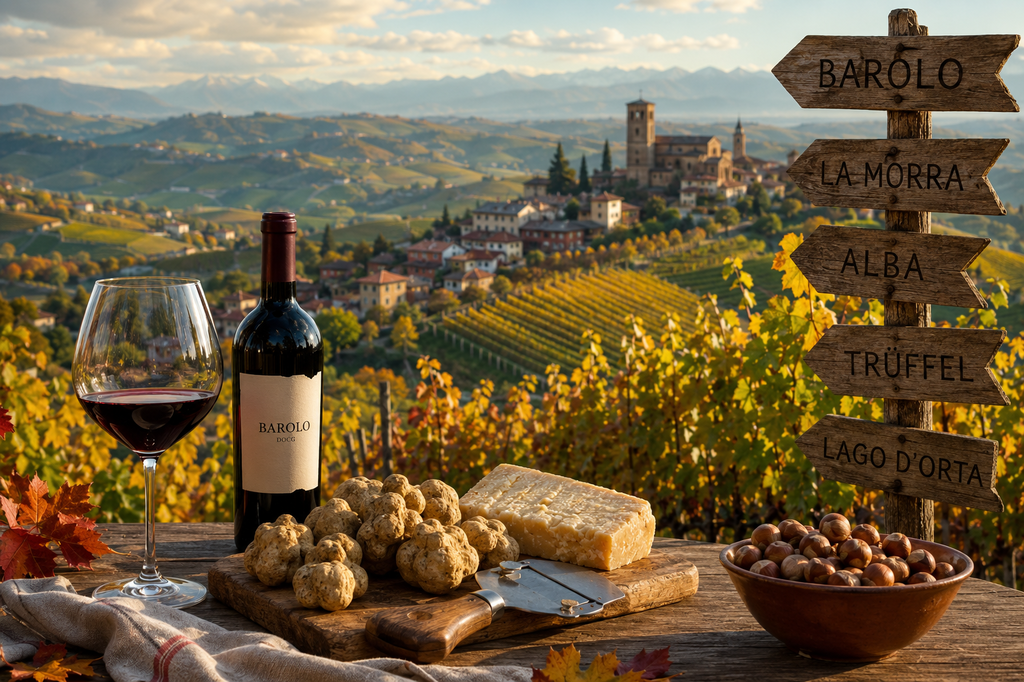
There are destinations that you only truly understand once you’re there. Sitting on a terrace overlooking vineyards that stretch in endless, gentle waves to the horizon. A glass of Barolo in your hand, its aroma ranging from roses and cherries to something almost indescribable. In the background, the soft clatter of a kitchen from which tajarin with white truffle is about to emerge.
That is Piedmont. And if, as you read this, you’re thinking you should have gone there – then you’re right.
In 2025/2026, Piedmont is one of Italy’s most exciting destinations for German-speaking holidaymakers who prioritise enjoyment, tranquillity and authenticity over mass tourism and glossy backdrops. This region in north-western Italy lies between the Alps and the River Po, bordering France and Switzerland – and produces some of the world’s finest wines, the most exquisite white truffles and a cuisine that has been delighting food critics for years.
What Piedmont doesn’t yet produce: the hordes of tourists that push other regions of Italy to their limits during the high season. The window of opportunity is open. Make the most of it.
Where is Piedmont – and what makes it so special?
Piedmont literally means ‘foot of the mountain’ – and the name aptly describes the region. To the north and west, the Alps encircle the region like a natural semicircle; to the south and east, the Po Valley opens out. Turin is the capital, an underrated metropolis with a Baroque cityscape, world-famous museums and a café and aperitivo culture that makes every visit worthwhile.
But the heart of Piedmont does not beat in the city. It beats in the hills south of Turin – in the Langhe, the Roero and the Monferrato. In those vineyards which have been a UNESCO World Heritage Site since 2014 and which Falstaff and international wine guides praise to the skies year after year.
Added to this, in the north-eastern part of the region, is a lake landscape of tranquil beauty: Lake Orta, one of the most romantic and least crowded lakes in northern Italy. Smaller than Lake Garda, quieter than Lake Como, with a medieval island at its centre and villages on its shores that seem to measure time at a different pace.
This combination – UNESCO wine country, white truffles, tranquil lakes and an Alpine backdrop – makes Piedmont something you won’t find in this form in any other region of Italy.
Wine routes and the Barolo hills: exploring the UNESCO World Heritage Site
To say Piedmont is to say Barolo. And to say Barolo is to speak of one of the world’s finest red wines.
Barolo is produced from the Nebbiolo grape in a strictly defined area south-east of Alba – in towns such as La Morra, Barolo itself, Castiglione Falletto, Serralunga d’Alba and Monforte d’Alba.
Each of these towns has its own character, its own style, and its own dynasties of winemakers. Together, they form a landscape that UNESCO has rightly classified as exceptional: rolling hills with perfectly arranged vineyards, punctuated by medieval towers, castle façades and red-brick country houses.
La Morra offers perhaps the most impressive panoramic view of the Langhe – from the church square, the view stretches across the vineyards to the snow-capped Alpine peaks in the background. Alba is the lively ‘capital’ of the wine region: with a magnificent medieval town centre, excellent restaurants and the world-famous White Truffle Market in autumn, which attracts gourmets from all over the world.
To the east of the Langhe lies the Monferrato – hillier, less well-known, but with a character all its own. There are historic villages such as Neive and Castiglione Tinella, wineries producing Barbaresco and Moscato d’Asti, and a tranquillity that no longer exists in other regions of Italy at the height of summer.
The Roero, on the other side of the River Tanaro, is the less-visited counterpart to the Langhe: gentler, with white Arneis wine and a landscape that seems even more unspoilt than the more touristy vineyards across the river.
The 2014 UNESCO designation is not merely a marketing term – it is recognition of a centuries-old cultural landscape that is unique in its continuity and authenticity. Anyone exploring the area with a holiday home as their base is moving through a living World Heritage Site.
Truffles, cuisine and autumnal magic: Piedmont for connoisseurs
There is a substance that costs more per gramme than gold yet still draws thousands of people to the Piedmontese hills every year. The white truffle (Tuber magnatum pico) from the Alba area and parts of Monferrato is considered the finest food in the world – and nowhere else does it grow in such quality and abundance as here.
The truffle season begins at the end of September and runs until December. Anyone visiting Piedmont during this time will experience something almost surreal: in the early hours of the morning, the trifolao – the truffle hunters – roam the woods with their trained dogs. At Alba’s markets, these tuberous, earthy treasures are piled high behind glass. In restaurants, dishes are finished at the last minute with freshly shaved white truffles, so that the aroma fills the entire room.
The Alba White Truffle Market takes place every autumn from October to November and is one of the world’s most famous culinary pilgrimage sites. Before, during and after the market, there are guided truffle hunts with genuine trifolaio, cookery courses in Piedmontese kitchens and truffle-based menus in restaurants renowned for this one dish.
But Piedmont has far more to offer than just truffles when it comes to cuisine.
Piedmontese cuisine is distinctive, profound and a world away from any kind of tourist fare: tajarin – wafer-thin, egg-rich pasta – served with butter and white truffle or with a slowly simmered ragù. Brasato al Barolo – beef braised in Barolo, cooked for hours until the meat and wine merge into an indistinguishable whole. Vitello tonnato in its original Piedmontese form. Bagna càuda – the hot dip made from olive oil, garlic and anchovies, into which you dip raw and cooked vegetables, and which is enjoyed in autumn at long tables with friends.
And the wines: alongside Barolo and Barbaresco, there is Dolcetto d’Alba as a lighter, more approachable accompaniment. There’s also Barbera d’Asti with its lively acidity and the white Arneis from the Roero. For a dessert to round off the meal, the sparkling Moscato d’Asti is a good choice. A stay in Piedmont is a wine journey, whether you plan it or not.
Lakes and tranquil hills: Why a holiday home is the best choice
A hotel in Alba or in one of the Barolo villages has its charms. A holiday home in this countryside is something fundamentally different.
It’s that morning when you sit on your own terrace and see the vineyards shrouded in the morning mist – that characteristic ‘Nebbia’, the autumn mist of the Langhe, which transforms the landscape into something unreal in its beauty and gave the Nebbiolo wine its name. It’s the evening when you’re standing in your own kitchen with produce bought at the market in Alba. It’s the freedom to spontaneously drive off at 10 o’clock in the morning to a vineyard that was recommended to you yesterday over dinner.
Holiday homes in Piedmont range from simple agriturismi set directly on vineyards to historic country houses with mountain views. The variety is enormous, and competition for the most outstanding properties is – as yet – manageable.
A special example: the Bellavista Dimora Storica Vista Lago in Miasino on Lake Orta. A historic house on a sun-drenched terrace above the lake, overlooking the tranquil waters and the wooded hills of the opposite shore. Miasino lies above Orta San Giulio – the most picturesque village on the lake. This village boasts narrow alleyways, a medieval palazzotto and the small island of Isola San Giulio with its Romanesque Basilica. The island can be reached by boat in just a few minutes.
Lake Orta is the quiet counterpart to the vast Piedmontese lakes. Smaller than Lake Maggiore, without the mass-market hotels of Lake Garda, it has an atmosphere more reminiscent of a forgotten fairy-tale lake than a tourist hotspot. And that is precisely what makes it so special.
From Miasino, the wine regions of the Langhe and Monferrato are easily accessible – ideal for a week combining the tranquillity of the lake with wine-tasting adventures.
The best time to visit Piedmont: grape harvest, truffle season and mild summers
Piedmont has no bad season – but it does have a standout one.
Spring (April–May) is the season of blossoming cherry trees and orchards. The vineyards are coming into leaf, the temperatures are mild, and the landscape is cloaked in a fresh, lush green. For walkers and cyclists, it is one of the most fascinating seasons.
Summers (June–August) are warm to hot, without the extreme temperatures of the south. The vineyards are in full green splendour, the lakes are perfect for swimming, and Piedmont is pleasantly quiet compared to classic summer hotspots. Anyone familiar with – and keen to avoid – the hustle and bustle of Lake Garda or the Amalfi Coast will feel right at home here.
Autumn (September–November) is Piedmont’s heyday – and the reason why gourmet travellers from all over the world flock here. The vineyards are ablaze with gold, orange and deep red. The grape harvest begins. White truffles emerge from the ground. The Langhe mist settles over the valleys in the morning and lifts by late morning to reveal a golden autumn day. The restaurants are at their very best. The wineries open their cellars.
Anyone who has experienced Piedmont in autumn will understand why culinary tour operators focus their programmes on these months. It is the time of year when everything comes together.
Best time to visit briefly:
- Wine, truffles, culinary delights: October–November
- Grape harvest, first autumn colours: September–October
- Hiking and cycling: April–May and September
- Lakes and summer warmth: June–August
Who is Piedmont best suited for?
Piedmont is not a one-size-fits-all destination – and that is its strength. It attracts people who know what they want.
Wine lovers and connoisseurs will find a concentration of world-class wines, excellent cuisine and culinary craftsmanship here that is unrivalled in Italy. No other destination combines Barolo, Barbaresco, white truffles and Piedmontese cuisine at this level.
Couples and those seeking peace and quiet appreciate the tranquillity of the Piedmontese hills, the romance of Lake Orta and the atmosphere of historic holiday homes, which are a common sight here. Piedmont has no crowded beaches and no tourist spectacles – instead, it offers something that has become increasingly rare: a genuine chance to slow down.
Active holidaymakers will find in Piedmont a network of cycle routes through vineyards, walking trails between lakes and the Alps, and well-signposted gourmet trails linking wineries, cheese dairies and truffle hunters. The route between Lake Orta, the Lake Alps and the Langhe wine region is one of the most impressive cycle routes in northern Italy.
Culture lovers will discover in Turin an often-overlooked masterpiece of Baroque urban planning, featuring the Egyptian Museum (the second largest in the world after Cairo), the Galleria Sabauda and an aperitivo culture that puts Milan to shame.
For anyone looking for alternatives to Tuscany: Piedmont is the answer. Anyone who loves Tuscany but now finds it too familiar, too crowded or too expensive will end up in Piedmont and immediately recognise the family resemblance. There are vineyards, historic villages and excellent cuisine – with a level of authenticity that is harder to find in Tuscany.
FAQ: Holiday home holidays in Piedmont
Is Piedmont a compelling alternative to Tuscany?
Yes – and for certain types of travellers, it’s the better choice. Those who prioritise wine, fine dining and tranquillity, and who want to avoid mass tourism, will find a more authentic, peaceful experience in Piedmont that’s at least as good in culinary terms. The Langhe landscape is comparable to Tuscany’s – but less developed and therefore more unspoilt.
Where exactly is the Barolo region?
The Barolo production area lies south-east of Alba in the Langhe region, at the heart of the Langhe Monferrato Roero UNESCO World Heritage Site. The main towns are La Morra, Barolo, Castiglione Falletto, Serralunga d’Alba and Monforte d’Alba – all within a 15–20-minute drive of one another.
When is the best time for a truffle tour in Piedmont?
The peak season for Alba white truffles runs from early October to late November. The Alba White Truffle Market takes place during this period. If you’d like to go on a guided truffle hunt, you should plan your trip for early October to mid-November.
Is a holiday home on Lake Orta a good base for wine tours?
Absolutely. Lake Orta is around 80 kilometres from Alba – ideal for day trips to the Langhe and Monferrato. As a holiday home base, it offers the advantage of a peaceful, romantic lakeside setting combined with easy access to the wine region.
Which wine regions are in Piedmont?
The most important are the Langhe (Barolo, Barbaresco, Dolcetto d’Alba), the Monferrato (Barbera d’Asti, Grignolino), the Roero (Arneis, Roero Rosso) and the Astigiano (Moscato d’Asti, Asti Spumante). Together, they form one of the world’s most densely concentrated wine regions within a very small area.
Who is Piedmont less suitable for?
If beaches and the sea are your main priorities, Piedmont is not the place for you. The region is situated in north-western Italy and has no access to the sea. For beach holidays, Liguria, the Tuscan coast or southern Italy are the right choice. Piedmont is for indulgence, tranquillity, wine and nature – not for beach holidays.
Conclusion: Piedmont awaits – but not forever
Piedmont is not yet an overcrowded destination. The vineyards of the Langhe are not yet subject to the constant high-season pressure of Tuscany. Lake Orta is not yet as well-known as Lake Garda. The restaurants in Alba aren’t yet fully booked months in advance.
That’s set to change. The combination is simply too exquisite, the culinary heritage too unique, the landscape too enchanting. Those who visit now will experience Piedmont at a time when the quality of the experience and the tranquillity of the surroundings still go hand in hand – without compromising on either.
Barolo in your glass. White truffles on your plate. Vineyards stretching to the horizon. And a holiday home waiting for you.
All information regarding seasons, events and travel periods is for general guidance only and may vary from year to year. Please check the latest truffle market dates and event times before you travel.