
- Multi-generational Holidays In A Holiday Home: How To Make It Work With Granny, Teenagers And Toddlers In A Villa
- Sea Kayaking Along The Tuscan Coast: Explore Caves, Coves And Islands From The Water
Via Francigena: Why this pilgrimage route can be the experience of a lifetime
Early in the morning, just after six. The mist still hangs in the valleys; the cypress-lined avenues are little more than dark silhouettes against the grey. You’re standing on a gravel path somewhere between Siena and the Val d’Orcia, hearing nothing but your own footsteps and the occasional toll of a church bell from a village that is still asleep. You haven’t said any prayers. You’re not a believer. And yet you know: you’ll never forget this moment.
That is exactly what the Via Francigena is. Not a Way of the Cross, not a penitential walk, not a compulsory spiritual journey – but one of Europe’s most beautiful hiking trails, which just happens to follow a millennia-old pilgrimage route. And the question that holds many potential hikers back – do I have to be religious to walk this route? – can be answered in a single sentence: No. Not in the slightest.
This article shows you what you can really expect on the Tuscan section: which stages are the most beautiful, how to prepare – and why this trail changes people who just wanted to go hiking.
What exactly is the Via Francigena?
From Canterbury to Rome – a route that Europe had forgotten and is now rediscovering. The story begins in the year 990 AD. Archbishop Sigerich of Canterbury travels home from Rome, documenting every single stage of his journey – 80 stops, from the Eternal City to the English coast. What he describes is not a new route, but an ancient one: a path along which pilgrims, merchants, armies and envoys have travelled through Europe since the early Middle Ages. Rome’s appeal was religious, but the route itself was everything: a trade route, a communication route, the cultural lifeline of an entire continent.
Today, the Via Francigena is an official cultural route of the Council of Europe, well signposted, largely digitised and growing in popularity year on year – not despite its history, but because of it. Those who walk this path tread on the very same stones upon which Dante is said to have travelled, upon which Frederick Barbarossa marched, upon which ordinary people from all over Europe carried their hopes and fears. That alone – without any prayer at all – is a moving thought.
The Tuscan section – the true heart of the entire route
The Via Francigena runs from Canterbury to Rome, covering a total of around 2,000 kilometres. But it is no secret that not all sections are equally beautiful. Among connoisseurs, the Tuscan section is regarded as the true heart of the route. The route begins in Lucca and leads via San Miniato, San Gimignano and Monteriggioni to Siena and on into the Val d’Orcia – 220 kilometres, nine daily stages, with a density of scenery and culture that hardly any other hiking trail in Europe can match. Hills topped with avenues of cypress trees, medieval towers on the horizon, vineyards in the autumn light, white gravel roads – the famous Strade Bianche – secluded abbeys and thermal baths after long days. It is no coincidence that the Tuscan section is the most popular part of the entire route.
Who is walking here today – an honest assessment
The majority of those hiking the Via Francigena are no longer motivated by religious reasons. A colourful mix of couples seeking a shared adventure, solo travellers needing a break from everyday life, pensioners wanting to experience something grand after the end of their working lives, athletes wishing to combine fitness with culture – and yes, believers for whom this path holds deep spiritual significance. Everyone walks the same path. Everyone respects one another. No one asks the others why they are there.
Pilgrimage without faith – is that possible
The word ‘pilgrimage’ carries a heavy burden. It conjures up images of penance, of kneeling on hard stone, of collective piety. It can be all those things – but it no longer must be. In its purest form, pilgrimage describes something much simpler: a long journey on foot, with your own body as your sole means of transport, free from the distractions of modern life. No car to whisk you from A to B, rendering everything in between invisible. No aeroplane to compress a 200-kilometre stretch of countryside into two hours. Just you, your legs and the landscape unfolding before you step by step. That sounds simple. And it is simple. And that is precisely where the transformative power lies.
What you find along the way – and what you let go of
Hikers who complete the Via Francigena describe remarkably similar experiences afterwards – regardless of whether they are religious or not.
The first thing to disappear: decision fatigue. On the trail, there are no 47 restaurant options to compare, no inbox to sort through, no social media feeds to scroll through. The only decision is keep walking or take a short break. This radical simplification does something for the mind that hardly any other holiday manages to achieve.
The second thing that happens: time stretches out. A day on the trail is not a day that flies by. It is a long, vivid day with a clear beginning, middle and end. In the evening, you know exactly what you have done: you have covered 18 kilometres of Tuscany under your own two feet. This feeling is hard to describe and even harder to forget.
People who talk about it after the hike say things like: ‘After three days, I stopped looking at my mobile.’ Or: ‘The exhaustion in the evening was different from office exhaustion. It was satisfying.’ Or, most honestly: ‘It sounds dramatic, but the trail showed me what is essential to me.’ No religious explanations are needed for this.
Etiquette along the way – respect Without pretending
A question that sometimes concerns non-religious people: how should one behave when staying overnight in a monastery or meeting a fellow pilgrim who is religious? The answer is simpler than one might fear. The Via Francigena is not a sacred space that imposes special rules of conduct. Basic respect is enough: enter churches and monasteries quietly, leave fellow pilgrims to their rituals in peace, and thank your hosts warmly.
No one will ask about your faith. No one expects you to join in prayer. Most monasteries that take in pilgrims do so out of a long tradition of hospitality – and this hospitality extends to all who are on the way. A sincere thank you counts for more than any feigned piety.
The 9 stages through Tuscany – a journey in pictures
What follows is not a dry route map. It is a preview of what awaits you – so you know what you’re getting yourself into.
Lucca – the perfect starting point
There are worse places to begin an epic hike. Lucca welcomes you with one of Italy’s best-preserved city walls – wide enough to cycle along, lined with trees, offering views of tiled roofs and the Apuan Alps in the background. Piazza Anfiteatro, built on the foundations of a Roman amphitheatre; the narrow streets with bicycles on every corner; the leisurely pace of a city that doesn’t need to bend over backwards to be beautiful – Lucca is the sort of place where you want to stay longer than planned.
Lucca is ideal for the journey itself. The city is easily accessible from Germany by train or plane via Pisa. It is also compact enough to find your bearings on the day of arrival and has deep historical roots in the history of the Via Francigena. In the Middle Ages, the city owed much of its wealth to trade along this route. You’ll be walking along roads where generations of merchants and pilgrims have headed in the same direction.
San Gimignano – the moment you’ve been waiting for
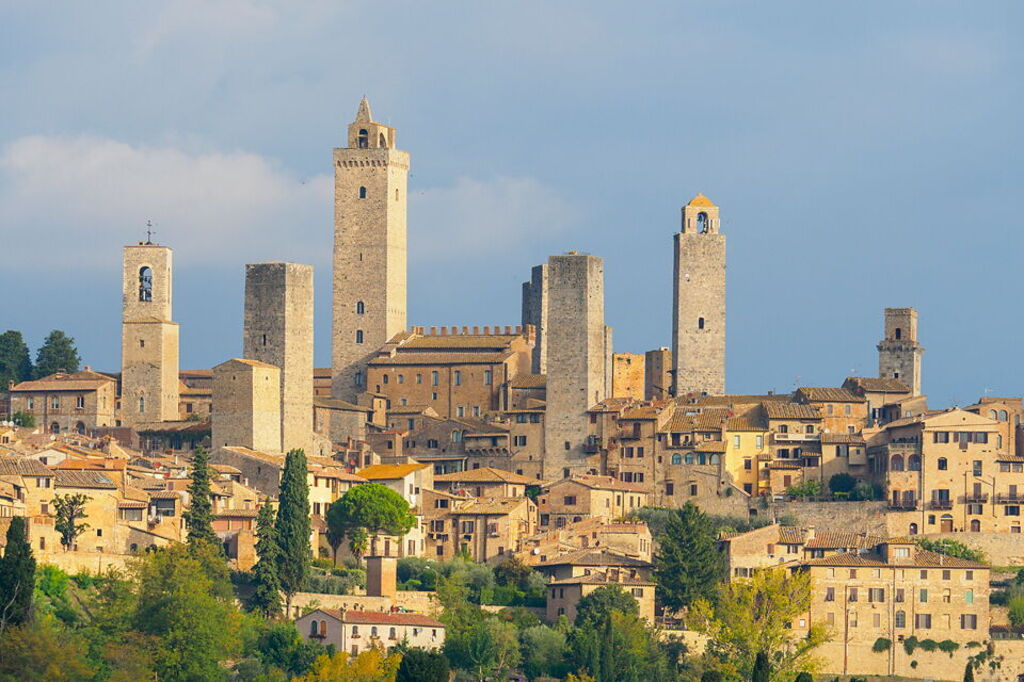
Stage four is short – just 13 kilometres. But it is the most emotionally powerful stage of the tour, and almost every Francigena walker will tell you the same thing: the moment the towers of San Gimignano first appear on the horizon is unforgettable. You’re tired, your feet might be aching, the path leads uphill once more – and then you see them. Fourteen medieval family towers rising from the hill like a miniature skyline from another era. A UNESCO World Heritage Site since 1990. No photo truly captures this sight. The photo comes later. For now, you carry on.
Monteriggioni – A fortress as a day trip destination
Monteriggioni appears out of nowhere. You walk through vineyards and olive groves, round a bend – and there it stands: a fully preserved medieval walled enclosure with 14 towers, encircling a small village as if time had been in no hurry since the 13th century. Dante mentioned Monteriggioni in the Divine Comedy. You will understand why he remembered it.
Siena – Arrival at Europe’s most beautiful piazza
The next day takes you along the Strade Bianche – those white gravel roads famous for the cycle race of the same name, which have a mythology all of their own in Tuscany. Dusty in summer, soft and heavy after rain, gleaming like limestone in the sunshine. And at the end of this day, after 19 kilometres: Siena.
You enter the city through an ancient city gate, walk through narrow alleys that wind their way downhill, and then – the Piazza del Campo. One of the most beautiful town squares in the world. A shell-shaped cobblestone square, lined with medieval palaces, with the Torre del Mangia towering above it all. You sit down at the edge of the square. You order an espresso or go straight for a Campari. You laugh because you’ve made it this far. This is no religious experience – it is a human one.
The Crete Senesi and the Val d’Orcia – Tuscany beyond the postcard
Those who continue their journey to Siena enter a different Tuscany. The Crete Senesi to the south of the city is a peculiar, almost surreal landscape: gentle clay hills without trees, which in certain light look like a golden-brown lunar landscape. In spring they are lush green, in summer ochre-coloured, in autumn almost red. No travel guide captures these colours. And then there is the Val d’Orcia: a UNESCO World Heritage Site since 2004. It is famous for its cypress-lined avenues, its medieval villages and a landscape that has been painted and photographed so often that one almost forgets it is real. You walk right through it. On foot. That is the difference.
Practical preparation – what you really need to know
The Via Francigena is not a high-altitude mountain trail. No glacier crossings, no via ferrata. On average, each stage involves an ascent of around 340 metres and is just under 19 kilometres long – manageable for anyone who walks regularly and has no serious joint problems. The biggest mistake beginners make not training enough beforehand. Not because the route is too difficult, but because unbroken-in feet will develop blisters by day two and unbroken-in shoes will be hell by day three. Walking five to ten kilometres a day in your walking boots for two to three weeks beforehand is sufficient preparation. Your body will learn the rest along the way.
The Credenziale – the pilgrim’s passport (also for non-religious travellers)
The Credenziale is a small cardboard booklet that you can obtain before setting off – from the German Pilgrimage Office, online or directly in Lucca. At every stage, in every town, you receive a stamp. It sounds like a tourist activity. It is – but in the best possible way. At the end, you’ll hold a physical record of your journey in your hands, with stamps from churches, hostels, bars and small parish offices, which together form a kind of diary that no photo can replace. In practical terms, the Credenziale grants access to pilgrim hostels and accommodation that only take in pilgrims – often at significantly cheaper rates than standard accommodation. You don’t have to be religious to apply for it. You just must be on the path.
Luggage transport – the best confession
Many Francigena walkers only admit it after the trip: they had their luggage transported. And they’d do it again in a heartbeat. Luggage transport means: your suitcase is collected in the morning and is waiting for you at your accommodation in the evening. You walk with a small daypack containing only water, a jacket and the essentials. For beginners, older walkers or people with back problems in particular, this option makes the difference between an unforgettable memory and an orthopaedic emergency. Depending on the provider, the cost is between 8 and 15 euros per stage.
Essential kit – short and to the point
No 20-point packing list. Just the essentials: well-broken-in walking boots (no other item on this list comes anywhere near being as important), blister plasters applied preventatively before it hurts, a water bottle with a capacity of at least 1.5 litres, SPF 50+ sun cream and an offline map app such as Komoot or the official Via Francigena app. Trekking poles aren’t compulsory, but they take a lot of the strain off your knees on the downhill sections – and by day four, your knees will be grateful for any help.
Conclusion: A trail for anyone who wants to walk
The Via Francigena needs no justification in the form of faith, a crisis or a midlife moment. It is a very long, very beautiful trail through one of the world’s most stunning landscapes – with so many centuries of history under your feet that even the most stoic non-romantic will eventually find themselves lost in thought.
What you need to bring: time, a pair of good shoes and the willingness to slow down for a few days compared to the rest of the world. What you get in return: it’s hard to put into words. But everyone who has done it says the same thing. It was more than just a hike.