
- Exploring The Local Area With The Vespa Guide: Short Trips From Your Holiday Home
- Via Francigena: Why This Pilgrimage Route Can Be The Experience Of A Lifetime
Multi-generational holidays in a holiday home: how to make it work with granny, teenagers and toddlers in a villa
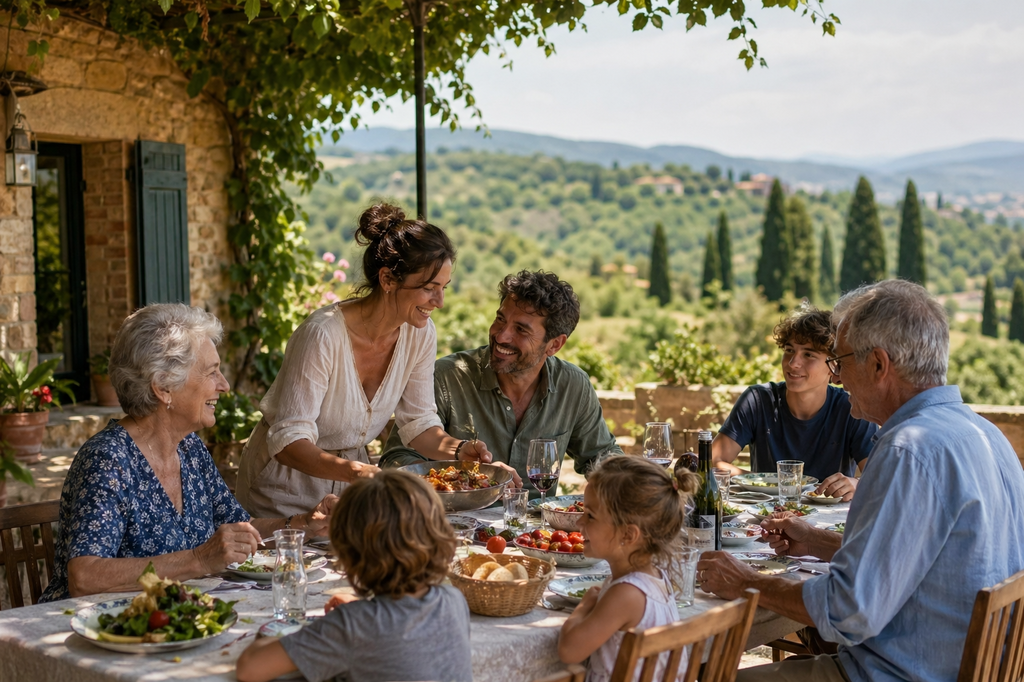
A holiday where every generation is truly happy sounds, at first, like a minor miracle. Granny wants peace and quiet and comfort. The teenagers want Wi-Fi, privacy and not just ‘family activities’ every day. The toddlers need safety, a routine and plenty of space to play. And the parents? They want one thing above all else: relaxation without constant stress.
This is precisely where a multi-generational holiday in a holiday home in Italy can really shine. Instead of lots of small hotel rooms, fixed mealtimes and little flexibility, a spacious villa offers exactly what large families need: space, freedom and the chance to consciously spend time together. Family villas in Tuscany are particularly popular – and for good reason. The region combines nature, culture, good food, relaxing day trips and often exactly the kind of properties that are ideal for large families.
However, to ensure your holiday doesn’t end in chaos but becomes a trip that everyone will fondly remember later, you need more than just a nice place to stay. The key factors are proper planning, a well-thought-out room layout, enough bathrooms, quiet spaces for every age group, and a realistic itinerary.
Why a holiday home is often the best choice for a multi-generational holiday
A hotel can work wonderfully for couples or small families. But when three or even four generations travel together, traditional accommodation quickly reaches its limits. Even organising breakfast times, the little ones’ naps or different sleeping patterns becomes complicated.
A holiday home or villa solves many of these problems in a very practical way. There are communal spaces for socialising and, at the same time, enough privacy if someone needs some peace and quiet. Those who get up early can have a coffee without waking the whole family. Those who want to stay up later in the evening can do so without having to whisper in a hotel corridor.
More flexibility than in a hotel
A multi-generational holiday in a holiday home in Italy works so well precisely because Italy itself is tailor-made for slow, shared travel. Food is a top priority, the daily routine is often family-friendly, and many regions are perfect for alternating between a day by the pool, a stroll through the village, a visit to the market and a short excursion.
Why Tuscany is particularly popular
Tuscany is particularly attractive in this regard. A family villa in Tuscany often offers spacious layouts, outdoor areas, terraces, several bedrooms and, not infrequently, a garden or pool. These are not luxury extras, but genuine stress-relievers on a multi-generational holiday.
The room layout determines the success of your holiday
Many families focus first on the price, the location or the pool. Understandable – but in practice, the room layout is often the factor that determines whether the stay will be harmonious or not.
Taking the needs of all generations into account
It is important to take the needs of different generations seriously. Grandparents often go to bed early and do not want to be disturbed at night by a baby monitor, loud footsteps on the stairs or teenagers laughing in the hallway. Families with young children need everything to be within easy reach, especially at night. Teenagers, on the other hand, appreciate having their own room or at least a space where they do not feel constantly watched.
Creating clear living and sleeping areas
A villa with clearly defined zones is ideal. A sleeping area on the ground floor can be practical for older guests, especially if stairs are difficult to navigate. Families with small children also benefit from a bedroom close to the living area or with direct access to the bathroom and terrace. Teenagers often feel more comfortable in a more secluded part of the house, such as upstairs or in a side room set slightly apart.
Don’t just focus on the number of beds
The number of beds alone is not enough as a criterion. A house with ten beds sounds spacious but can still be impractical if two families must pass through a connecting room or children can only sleep in the living room. That’s why it’s worth taking a close look at the floor plan. If you can see at the booking stage where privacy, peace and quiet, and family togetherness are possible, you’ll save yourself a lot of arguments later.
Multiple bathrooms are not a luxury, but almost a necessity
Anyone who has ever holidayed with eight or ten people in a house with just one bathroom knows: it sounds feasible in the advert but quickly becomes a nightmare in everyday life. In the morning, several people want to shower, children need washing, someone takes longer in the bathroom, someone else wants to leave early.
How many bathrooms make sense
For a successful multi-generational holiday, there is therefore a simple rule: better one bathroom too many than one too few. Two bathrooms should be the absolute minimum for larger families; three are much more relaxed. A layout with at least one bathroom per floor or per sleeping area is particularly practical.
Which facilities really make a difference
For families with young children, a bath is a real bonus, whilst older travellers often benefit from a walk-in shower. A combination of both is even better. An additional guest toilet takes a huge strain off the main bathrooms – especially in the evenings or when several people are in the house at the same time.
However, having several bathrooms isn’t just about comfort. It reduces friction. And that is precisely what a multi-generational holiday is all about: not making everything perfect but avoiding unnecessary conflicts from the outset.
Spaces to retreat to: travelling together doesn’t mean being together all the time
Many families confuse harmony with constant togetherness. Yet relaxed closeness often only arises when everyone is allowed some space now and then. This applies to all age groups.
Why having space to retreat is important for every generation
Grandma might want to read or lie down in the afternoon. Teenagers want to scroll through their phones, listen to music or simply have some peace and quiet. Toddlers need a nap or a safe play area. Parents sometimes simply long for ten minutes without questions, requests and noise.
What kind of private spaces a villa should offer
A good family villa in Tuscany provides exactly these opportunities. This could be a second living room, a shaded terrace, a garden area, a reading corner, a balcony or a separate bedroom where you can truly retreat. Different zones are also helpful outdoors: a dining table for everyone, a quiet corner for adults, a safe place for small children to play.
It is crucial not to view these retreat spaces as an afterthought, but as an integral part of the holiday setup. Those who are allowed to slip away for a short while usually return feeling more relaxed. This transforms ‘We have to do everything together’ into a much healthier ‘We are consciously spending time together’.
Accessibility considerations: thinking about comfort for all generations
As soon as older family members join the trip, accessibility becomes a key consideration – even if no one is officially classified as requiring care. Even minor obstacles can become a struggle on holiday: steep stairs, narrow showers, high door thresholds, slippery floors or long distances from the car park to the house.
What families should look out for when booking
When choosing a holiday home, it is therefore worth paying attention to practical details. Is there at least one bedroom on the ground floor? Is there a walk-in shower? Are there handrails? Is access to the house straightforward? How far is it to the nearest supermarket or restaurant? The condition of the outdoor area also plays a role. Natural stone, steps and uneven paths may look charming, but they are not comfortable for everyone.
Barrier-free design also makes sense for families with young children
Barrier-free does not mean sterile or clinical. Many high-quality villas in Italy combine character with practicality for everyday living. Paying attention to these aspects early on ensures safety and independence – two factors that are often more important to older travellers than any view.
And barrier-free layouts also pay off for families with young children. Where there are no trip hazards, open staircases or complicated routes, everyday life is automatically more relaxed.
Planning the perfect trip: less on the agenda, more quality
A common mistake on multi-generational holidays is an overloaded itinerary. You want to see as much as possible, cater to everyone’s tastes and ‘make the most’ of every region. In the end, everyone is exhausted. The little ones are whingeing, the teenagers are fed up, Grandma is tired, and the parents feel more like tour guides than holidaymakers.
Tuscany thrives on small experiences
A different approach works better: fewer activities, but well planned. In Tuscany in particular, there’s often no need for long to-do lists. The region’s strength lies precisely in the fact that even small experiences offer plenty of atmosphere: a market in the neighbouring village, lunch with a view, a short stroll through a historic village, an ice cream in the afternoon, a quiet day by the pool.
A relaxed pace keeps everyone calm
For a successful multi-generational holiday, a relaxed pace is recommended. For example, a day out followed by a quiet day at the villa. Or half-day trips instead of full-day excursions. Do something in the morning, then head back to the house in the afternoon. This leaves plenty of room for spontaneous breaks, nap times and different needs.
The group can split up from time to time
It’s also helpful to organise outings according to energy levels. A city visit with cobbled streets, hunting for a parking space and a cultural programme is quite different from a village market or a picnic with a view. Families should ask themselves in advance: What is really feasible for everyone? Where is it worth splitting the group up? Perhaps the parents can go into town with the teenagers, whilst Grandma spends a relaxed afternoon at home with the toddler. This isn’t a sign of a lack of togetherness, but often the wisest solution.
How to make everyday life in the villa run smoothly
Even the most beautiful villa is no guarantee of a relaxing holiday. What matters is how the family organises their daily routine. Rigid rules won’t help here; simple agreements will.
Small routines make holidays easier
A major advantage of a multi-generational holiday in an Italian holiday home is the freedom to do as you please. You can have breakfast together, but you don’t have to. You can cook in the evening or go out for a meal. To ensure this freedom doesn’t turn into confusion, it’s a good idea to establish some small routines.
Who does the shopping? Who cooks and when? Are there set times for family dinners? Who will keep an eye on the children during their afternoon nap? Which days are deliberately left free of plans? Such questions don’t need to be planned with military precision, but a basic framework makes life easier for everyone involved.
Openly accepting differing expectations
Particularly important: keep expectations open. Not every generation has the same idea of a holiday. Whilst some think ‘finally, all together’, others want above all to relax. Both are legitimate. A good multi-generational holiday is therefore not one where everyone does everything together, but one where nobody must constantly adapt.
Why Tuscany works so well for large families
Tuscany’s popularity is no coincidence. The region offers a rare blend of landscape, culture and lifestyle that appeals to different age groups at the same time.
Benefits for grandparents, parents, children and teenagers
For older travellers, it is often the peace and quiet, the cuisine, the beautiful villages and the laid-back atmosphere. Parents appreciate the easy access to many attractions, the relaxed daily routine and the chance to really settle into a villa. Children benefit from gardens, pools, nature and short walks to the outdoors. Teenagers often find just the right balance of photogenic spots, their own space and good food.
The villa becomes the centre of the holiday
What’s more, a family villa in Tuscany is often more than just accommodation. It becomes the heart of the holiday. You sit on the terrace for a long time in the morning, return from the market at midday, cook together, read by the pool, play cards, watch the children romp about and enjoy the evenings without any hustle and bustle. That is precisely what makes this form of travel so valuable. Not the spectacular but being together with plenty of space.
Conclusion: The perfect multi-generational holiday starts with the right accommodation
A successful holiday with grandma, teenagers and toddlers is entirely possible – provided the setting is right. A hotel with rigid routines often fails to cater to the differing needs of several generations. A spacious holiday home, on the other hand, offers the flexibility that large families really need.
Anyone planning a multi-generational holiday in a holiday home in Italy should therefore pay particular attention to five things: a clever room layout, several bathrooms, proper private spaces, accessible facilities and relaxed excursion planning. If these points are taken seriously, the result is not a holiday full of compromises, but a type of trip from which everyone benefits.
A family villa in Tuscany is perfect for this. It combines comfort, atmosphere and freedom – and turns a logistical challenge into exactly what families want: shared memories that feel light-hearted and wonderful.
Because, in the end, it’s rarely the perfectly timed daily schedule that stays in the memory. It’s the simple moments: the long breakfast, the laughter by the pool, the peace and quiet in the evening, the feeling that everyone had their place. That’s exactly when a multi-generational holiday really works.