
- The Ideal Holiday Apartment For Beginners In Versilia: Where Is Your Dream House Located?
- Holiday Homes And Cycling Road And Gravel Cycling Hotspots Right On Your Doorstep
Without a car to the holiday home, Italy vacation by rail and bus—these locations truly function.
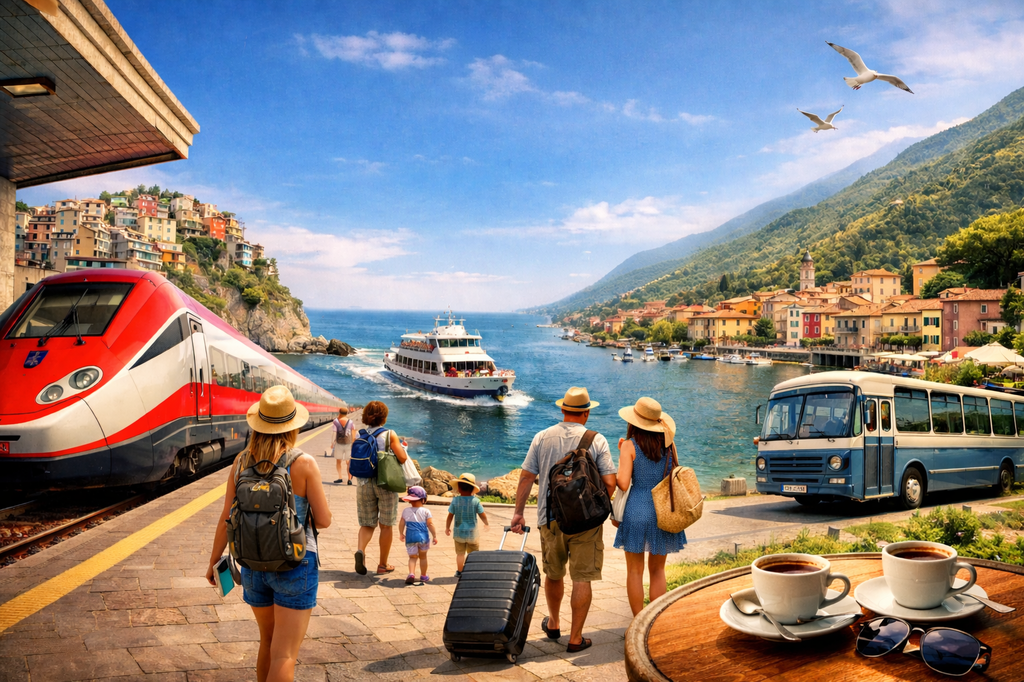
Assume you get off the train in Italy. The doors open, warm air fills the space, and within it is a faint smell of espresso and sunscreen. Instead of waiting in queue at the rental car counter or fretting about reaching a ZTL zone, you simply stroll out of the train station, have a coffee and know: Your holiday home is only a few easy steps away, a quick bus ride, or a ferry crossing.
This is what a car-free holiday in Italy looks like. And, yes, this is doable if you prefer to stay in a vacation house rather than a city hotel. The key is that your vacation property is train accessible, and that you choose a place where trains and buses are not a last resort, but rather a viable option.
This article is not about theoretical advice, but about areas that function in practice. And there's a simple system that allows you to quickly determine whether any accommodation is suitable for trains and buses.
How the "last mile" impacts your trip
The good news first: Italy's rail network is remarkably packed. Many cities are well connected, with rapid trains, regional trains, buses, and occasionally even ferries to get you there. The bad news: Your vacation property is rarely located directly on the rails.
The essential question is thus not simply: Will I travel to Italy by train? But above all, how do I go from the train to my front door in true comfort? This stretch, also known as the "last mile," affects whether your vacation starts well or not.
Two arrival scenarios: only one feels like a vacation
Assume you are travelling with two children and bags. The train arrives in a tiny coastal town, you disembark, and the promenade begins immediately in front of the station. You can walk to your holiday flat in ten minutes, and in the evening, you can take the same route to acquire ice cream. This is the finest choice.
Many people know the other version from painful experience: the train station is outside the city, the bus only runs every two hours, the holiday home is on a hill, and after the first hundred meters, you realise that "only 1.5 kilometres" uphill with a suitcase is quite different from what the map app suggested.
How to recognise a "good last mile"
The distance and slope between the train station and your accommodation, the frequency of buses or ferries, and your ability to manage your daily routine on foot once you get in Italy will all influence whether your holiday will be restful or exhausting without a car. Fortunately, there are some areas where this works perfectly, and we will begin with them first.
Cinque Terre and Ligurian Coast: car-free Is almost the norm
If there is one area of Italy where the car nearly becomes a secondary consideration, it is the Ligurian shore near the Cinque Terre. The five famous villages cling like colourful cubes to the cliffs above the sea, the roads are tiny, and parking spaces are rare - which is precisely why you can frequently get across here better by train, boat, or foot than by car.
Assume you arrive at La Spezia via train. Already at the train station, you realise that you are not the only one travelling without a car: people are carrying backpacks, hiking shoes, and daypacks. In only a few minutes, you can board a regional train to the Cinque Terre settlements. Your daily routine consists of short train excursions along the coast, stroll through alleys, hikes from town to village, or relaxing ferry rides that allow you to see your destination from the water.
Base options: village or on-site - either can be ideal
If you are looking for a holiday home or holiday flat, here are two main strategies: If you choose to stay in one of the villages, you should consider how you will manage your luggage and the altitude before booking. Many rooms are attractive, but only accessible via steps.
Alternatively, you can establish yourself in a well-connected location such as La Spezia or Levanto. Then your vacation house is train accessible, stores, restaurants, and the train station are all within walking distance, and you can choose which village or hiking route to visit each day. This manner, you can mix the charm of Cinque Terre with the benefits of a small town.
For whom is this region created?
This location is perfect for couples, groups of friends, and anyone who enjoys being active. In the morning, you take the train instead of driving, allow yourself to be driven along the coast, get off, and find yourself smack in the heart of life. The return trip to the vacation home is as straightforward. The car would rather be in the way here, which is precisely what makes the Cinque Terre so appealing for a deliberate car-free trip in Italy.
Lake Como: holiday home, train, and ferry—and you won't miss the car
Lake Como offers a different picture, but one that is as comfortable. Here, it's not the rocks that slow down the car, but the combination of train, bus, and boat that suddenly appears so appealing.
Suppose you are taking the train from Milan to the north. The train travels along the shore, the lake glistens, and the mountains are mirrored in the water. You get off at a point when the station almost effortlessly merges with the promenade. In a few minutes, you'll arrive at the waterfront road, which is lined with tiny taverns, cafés, and docks. Your vacation home is situated on a side street or somewhat above, with a view of the lake. The luggage and trip are manageable without the need to call a taxi once.
Everyday life by the Lake: ship vs. traffic jam
Everyday life without a car is almost pleasurable: if you want to visit another location, you board a ship rather than a vehicle. Instead of traffic bottlenecks on the lakeside route, you can take a boat ride where every metre is already part of the vacation. Regional trains and buses are available for local excursions. Many destinations around Lake Como are connected in such a way that, with some planning, you may take advantage of an astoundingly flexible public transport network.
This is great for connoisseurs, finest agers, photographers, and slow travellers. Allow yourself to drift without ever feeling "stuck."
Things to consider when choosing the location of your holiday home
The location in the village is important while choosing your holiday property. An apartment near the train station or in the town centre, with a ferry terminal and a grocery shop within walking distance, makes life much easier. A house high on the slope can be breathtakingly lovely, but you should consider whether you want to travel these elevation meters every day with luggage, a pram or shopping bags.
A train-accessible holiday property on Lake Como entails not only being close to the tracks but also having a realistic connection to the train station, dock, daily itineraries, and personal fitness level.
Puglia without a car: It works—if you plan it smartly
Many people dream of visiting Apulia, the heel of Italy's boot, because of its white towns, olive groves, blue sea, trulli, and masserie. At first glance, a rental automobile appears to be a requirement here. Anyone who has ever driven in the countryside is familiar with the huge fields and narrow roads where buses rarely run.
However, it is also determined by the location of your base. A car-free holiday in Italy is possible along major railway lines, such as those connecting Bari and Lecce. Many coastal communities have train stations or are connected by regional trains. The beach or the old town centre are often only a few minutes away from there.
The right centre: train hubs as starting points.
Consider renting a holiday flat in a coastal town with a rail station, local stores, cafés and possibly a weekly market. The train takes you on day trips to the next town, and when you get off, you're right in the centre. You return in the evening, walk a few blocks to your vacation house, and then relax on the terrace with a bottle of wine.
It is particularly crucial to check closely in Apulia. A single masseria in the middle of an olive grove can be idyllic, but without a car, you can rapidly become stuck here, especially when the sun is searing in the height of summer. A holiday house with train access, on the other hand, allows you to spontaneously board a train without having to immediately arrange a transfer.
Who should visit Puglia without a car and what are the limitations?
Apulia is ideal for individuals who wish to stay a little longer, enjoy exploring restaurants and markets, and are willing to change their travel plans slightly to accommodate the train network. Perfect for long-term tourists, foodies, and those who don't need to visit a new beach every day but rather to get to know an area well. At the same time, honesty is essential: the more rural and isolated the accommodation, the more probable you will require a vehicle. However, if you choose a holiday house in one of the well-connected areas, Puglia can become a region that can truly function without a car.
The "almost always" formula: coastal towns with train stations
Of course, there are many more locations in Italy where car-free living is successful. A pattern is emerging seaside communities located right on a railway line with a station in or near the town. When you locate a location where the train station almost blends into the town, the promenade, the old town, and the beach are all within walking distance, and there are a few bus routes that connect to the surrounding area, you have a solid candidate. Then travelling in Italy without a car is no more a pipe dream, but a reality: arriving by train, walking to the vacation house, taking excursions by bus or boat.
When route planning turns into a vacation feeling
Instead of asking yourself, "Where do we park?" with each set of directions, ask yourself questions like "When does the next ferry leave?" Or 'Do we really want to leave town today - or shall we just sit here and enjoy the day?'" Where such questions arise, the infrastructure is usually adequate enough that a vacation without a car does not seem like restriction, but rather freedom.
In three minutes, you can determine if a holiday property is train friendly.
The first step is to examine the map objectively.
A simple internal test will be useful for practice. You see a beautiful house online and wonder if it's train-accessible or a trap for individuals who don't own a car.
First, look at the map. Where is the nearest rail station exactly? Not as the bird flies, but on pavements. Then look at how the path looks. Are they streets through town or winding mountain roads? A one-kilometre journey may appear to be short on the map, but with a luggage and pram in the hot heat, it becomes a whole different undertaking.
Step 2: Use everyday routes instead of vacation photos
Next, consider your daily activities on location. Is there a grocery shop, bakery or bar nearby where you can get a morning cappuccino? If you require a taxi for everything, it probably doesn't meet the bill for a relaxing and independent vacation without a car in Italy. Consider: What does a typical day without an expedition look like? Can you walk to the stores, the beach, or for a stroll without needing to consult timetables every time?
Step 3: evening check - return journey with a positive feeling
Then the evening comes into play. Perhaps you'd want to go out for dinner in the evening, have a drink of wine, or take a stroll along the harbour. Will you stroll back to your holiday house after? Is there still a bus? Are there any taxis in the area? If you intentionally ask yourself these questions, you will quickly determine whether an accommodation is well-connected on paper or if it feels handy throughout your holiday.
Who finds a trip to Italy without a car particularly worthwhile?
When you've had the experience of getting off a train with light luggage and arriving straight in life, your viewpoint shifts. You quickly notice how much energy is wasted on parking, tolls, zones, and traffic. A car-free vacation in Italy is therefore particularly appealing to anyone who wants to free their thoughts and hands.
Couples appreciate the flexibility of not having to drive and the ability to have a second glass of wine during dinner without worrying about the return trip. Families avoid backseat conversations, traffic jams in the heat, and rushing to the supermarket in an overheated car. Best agers and single travellers love being able to rely on schedules and avoid having to navigate unfamiliar locations. Those who aim to travel responsibly frequently have a more intense experience with landscapes and distances on trains, buses, and boats.
Slow travel instead of racking up miles
Travelling without a car does not imply deprivation, but rather a different type of freedom: possibly slower, but more conscious. You spend less time travelling and more time arriving - at the destination, in everyday life, and with yourself. Your vacation house will not become a logistical centre from which you plan daily miles, but rather a spot you will always enjoy returning to.
Conclusion: With proper planning, these regions can be highly effective
Cinque Terre and the Ligurian coast demonstrate how easy it can be to travel without a car when trains and boats are part of daily life. Lake Como demonstrates that a vacation home may be accessible by rail while still located beside one of Italy's most beautiful lakes, with numerous excursion choices - just by boat rather than traffic bottlenecks. Puglia, on the other hand, demonstrates that even regions that appear to scream for rental vehicles at first appearance may function with trains and buses with strategic base locations.
By applying this logic and completing your own train checks for each lodging, the concept of "vacation without a car in Italy" becomes a very concrete plan. Choose a region with adequate connections, a location with a train station and day-to-day life nearby, and a suitable holiday property.
When you get off the train, it's not the start of an organisational marathon, but rather the beginning of your holiday.